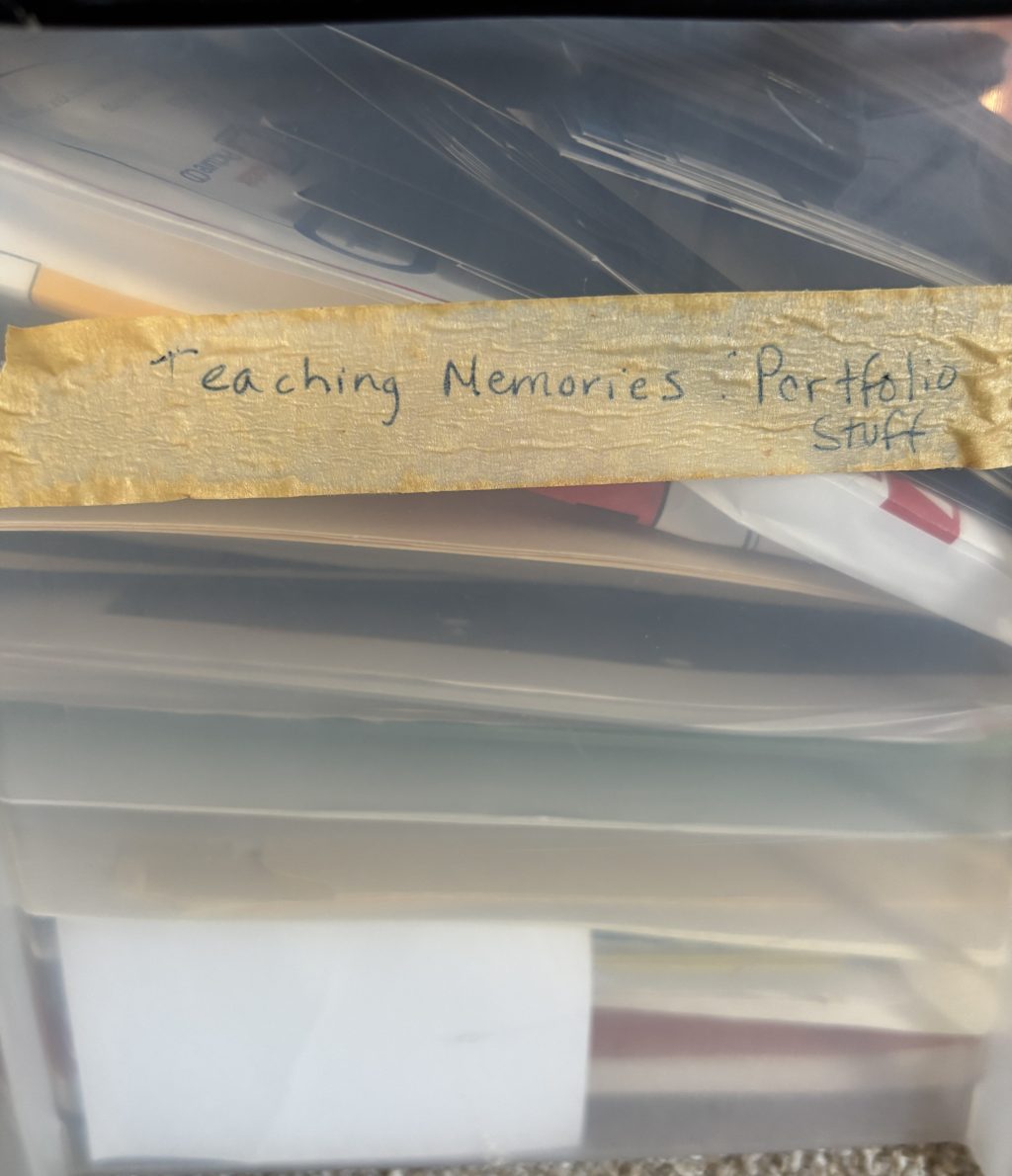
“Where is it?” I muttered to myself as I looked around the attic, mentally checking each pile of boxes. I had uncovered my teaching files, the kids’ early pictures, Tae Kwon Do trophies, and even my wedding basket. But the one box I wanted wasn’t appearing in my visual scan.
I knew it was there. I had looked at the pictures briefly when I had cleaned out the photo closet in our guest room during Covid. I had added them to my “teaching memories” box in the attic. I only had a few minutes to find the box before I had to change out of my “cookie party” outfit and into something more suitable for a 20th reunion.
I had started my day baking “crack,” what my friends and I jokingly have named pretzel bark. Most people at the annual cookie exchange agree that it is addicting, and typically, as soon as I walk in the door, someone asks, “Did you make crack?” I always do. This year I baked two trays, determined to bring home enough to satisfy my cravings while also giving everyone else a chance to take their fill.
Then I went to the party, decked out in my rainbow tree Christmas shirt. My husband, who thought I was going to wear an ugly sweater to the party, remarked “That’s not an ugly sweater. That’s a cute shirt!” I enjoyed the compliment, smiling as I headed out the door.
After some easy conversation with the cookie ladies, I headed back home, knowing I had just an hour to change for the 20th reunion of one of the first classes at a magnet school where I was one of the founding teachers. It was a school focused on STEM, and I ran the humanities program, combining English and social studies into a team-taught course. I taught this group of students their freshman and sophomore years, which meant I knew them well. It was a small cohort, but we had big conversations. It’s the kind of teaching experience that stays with an educator.
The reunion almost didn’t happen. Months earlier, while my son was navigating his own college process, I reached out to one of these former students who had attended a school my son was considering. At the end of the conversation, my thoughts drifted to 20 years ago, and I asked, “Remember the time capsule your class made freshman year that you were supposed to open at your 20th reunion? Shouldn’t that be this year?”
That question, it turns out, planted a seed.
This former student—who is no longer particularly young, who has children of his own, and who is now a university professor—nudged his classmates. Messages were sent. Plans were made. A reunion took shape. A few teachers were invited, and I was honored to be one of them.
I was excited to see them, even though it was my second social event of the day. As an introvert, I had to dig deep to face the social inputs. I knew that bringing the old pictures would give us something to talk about, a way to ignite easy conversation. I was frustrated that I couldn’t uncover them. As I scanned the attic – and sifted through the rollerdeck in my memory – my eyes landed on the back corner. A tickle in my brain told me that there was a good chance the box was back there. I started digging, and squealed with glee when I finally uncovered it, clearly labeled “Teaching Memories.” I hauled it down from the crawlspace and realized that the box contained so much more than the pictures. There were several artifacts that would inspire conversation and unlock memories.
Having spent so much time unearthing the box, I didn’t have a lot of time to change, so I was pleased when, for the second time that day, my husband complimented my outfit as I walked out the door. When I got to the restaurant, I immediately bumped into one of my former colleagues in the parking lot, followed immediately with greetings for the first of the students I would see that night. Everyone looked the same in my mind’s eye. We hugged, we laughed, we shared stories prompted by scenes in the pictures and artifacts I had scattered across the tables.
Ultimately, we didn’t have a time capsule to open, but we filled time sharing memories and life updates. There is something profoundly grounding about seeing former students as adults, not as the people they were, but as the people they became. It reminds you that the work you did mattered in ways you couldn’t see then and that the relationships you formed didn’t end when the class did. In some ways, time collapsed, and 20 years both existed and was erased as we reconnected, reflected, and shared time together.
 Filling Time: TwinLife Empty-Nesting
Leave a comment