I’m sitting in an airport, filling time by reflecting on the last week. Until yesterday, I expected to write about how I filled time with my brother, going to the gym, watching Paridisus, continuing to design the thing we have been talking about for nearly two decades. I was staying with him between work events in California, and I could not fill time by enjoying the weather (it was awful), so we just filled time in each other’s presence. It was good. It was natural. It’s something I’d like more of in my future.
And then a blizzard hit the northeast, so I ended up stranded in California longer than I had anticipated. Luckily, the weather turned, so I had a day full of sun in downtown LA, which opened up new opportunities to fill time.
I wrote last week about the Waymo, self-driving cars that I saw everywhere in San Francisco. They both fascinated and terrified me. The fact that one of my friends found them preferable to human powered ride-shares convinced me I should try one while I was on the West Coast, but I had neither the guts nor the opportunity.
A moment to reflect on the guts part of this equation –
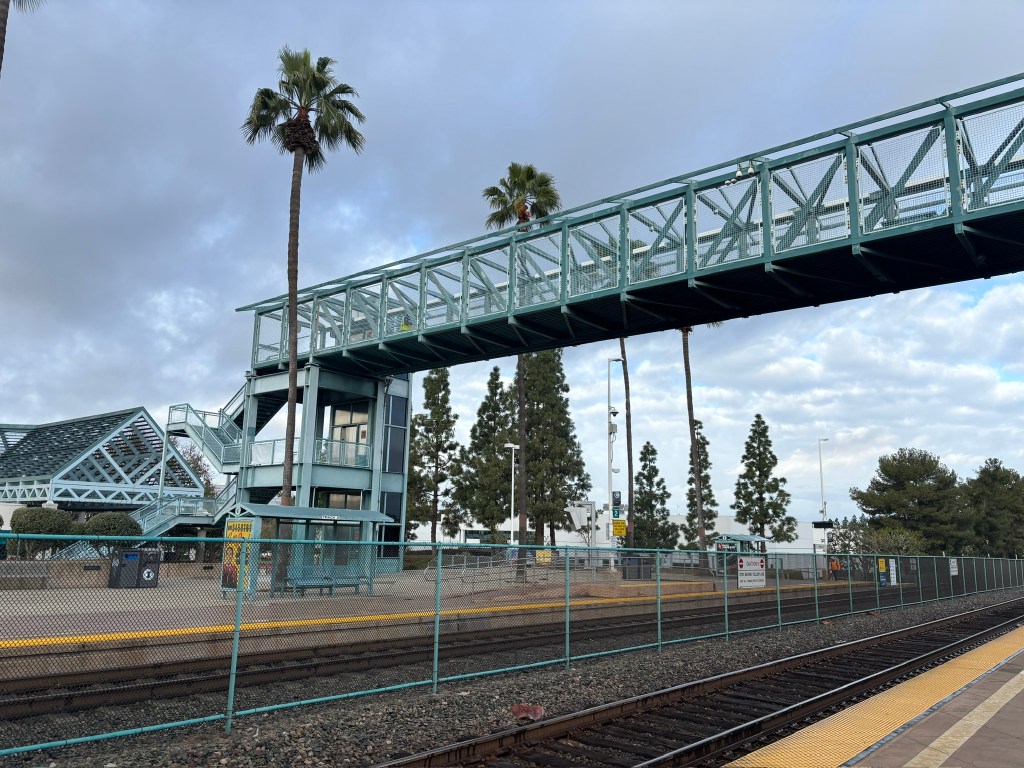
When I was 7, my parents took my brother and me to Sesame Place. One of the attractions was a rope jungle gym designed for climbing to the top. It was probably about 5 feet in reality, but in my mind it was the height of the Empire State building. In hindsight, it was the first time I recognized my fear of heights, which lives with me till today. In fact, after my brother dropped me off at the train station last week, I almost had a panic attack crossing to the other side of the tracks. I texted him this picture to show him where I nearly broke down – the open stairway nearly did me in.
At Sesame Place, the open ropes did me in. While my two-year-old brother climbed to the top, I froze mid-climb. My parents told me I didn’t need to go further and let me head back down – absolutely the right decision, by the way – but my failure to push past the fear has stuck with me. I never wanted fear to hold me back again. It’s why I pushed back the tears when I was stuck on the side of Seneca Rocks and climbed my way to the top when I was 17. I was not backing down again.
So, I knew that if I had the chance to ride in a robot car, despite my fear, I had to at least try it. And I knew I would have the chance on the ride from the train station to my hotel in LA. I told my brother I was going to do it. I downloaded the app. I prepared mentally.
And then when I got off the train, I faced pouring rain. The crappy California weather was giving my already tired soul another challenge, and I reverted to my comfort zone. I called an Uber.
I didn’t regret it at the moment, but I kept thinking about the robot car all weekend, especially because I was steeped in conversation about AI in education with some of my closest colleagues in the field. We are the ones who experiment with technology. We encourage others to do so. We say, “If you don’t play, you don’t know the possibilities or the limitations.” We push past our fears and jump in to do the things.
How could I possibly leave the West Coast after nearly two weeks, stranded in the middle of the rope gymnasium?
The first night, my group talked about Waymo. Only one person had done it. They loved it, just like my friend. They recommended it. They said they would go with me. A bunch of us said we would try together. The herd mentality made it easy to say “yes, I will.”
But we were tired from travel so we didn’t want to do it that night. We promised to go somewhere via Waymo the next night. That night, after we had spent all day in deep thinking and conversation about AI, we were even more tired. We could not fathom an hour round trip to see the Hollywood sign (this was our solution to where we should take the Waymo), when our beds were about four blocks away from the restaurant where we were eating. We thought about taking the Waymo back to the hotel (I mean, it couldn’t kill us in a 4-block ride, right?), but the cost didn’t seem worth the experience.
Without a gang, I gave in. But I was still thinking about the damn ropes at Sesame Place. How could I leave LA without trying the Waymo?
Luckily (yes, I’m saying that right now), a blizzard hit the East Coast, and I was stranded in LA. Also luckily, one of my friends had some extra time before his flight. He was the only member of our group to download the Waymo app besides me. I knew he was committed. We designed a plan that would allow us to take a Waymo to see the Hollywood sign and the Walk of Fame, the epitome of touring in LA, with just enough time for him to get to the airport.
The rest of this (longer than usual) post is co-written with Bud Hunt (@budtheteacher) and ChatGPT. Bud and I narrated our Waymo ride in real time, and ChatGPT took that transcript and cleaned it up, organizing our thinking just a bit. I filled in the details of the story. The main points Bud and I want to share are that (1) we saw something new, (2) we jumped in to try it, (3) we reflected on our experience AND what it might mean for society, and (4) we are somehow different because of it. I’ll leave you to ponder those points by reading our Waymo journey.
Standing in the hotel lobby, Bud called the Waymo on the app, very similar to Uber/Lyft. He looked at the map and said we need to walk to the street and turn left. He double checked a few times, zooming in on the app to verify we were in the right place. We waited, chatting amiably about our experience during the weekend. We were both just a bit nervous and also excited for this adventure. If Bud missed his flight, no problem. It was an adventure worth it. We could fail, and he would be ok.
The Waymo pulled up to the curb. Bud pushed “unlock door” in the app, and we discussed whether he should put his luggage in the trunk. Would he be able to get it back out later? I devised a plan that at the end of our ride, I would stay in the car and leave the door open until he figured out how to get his luggage. He opened the trunk manually and put his luggage inside.
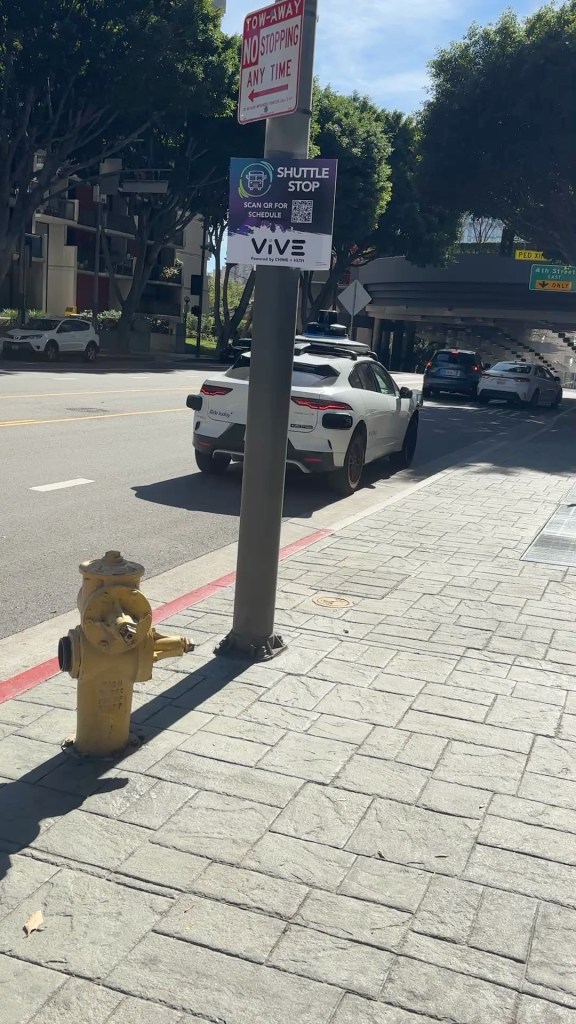
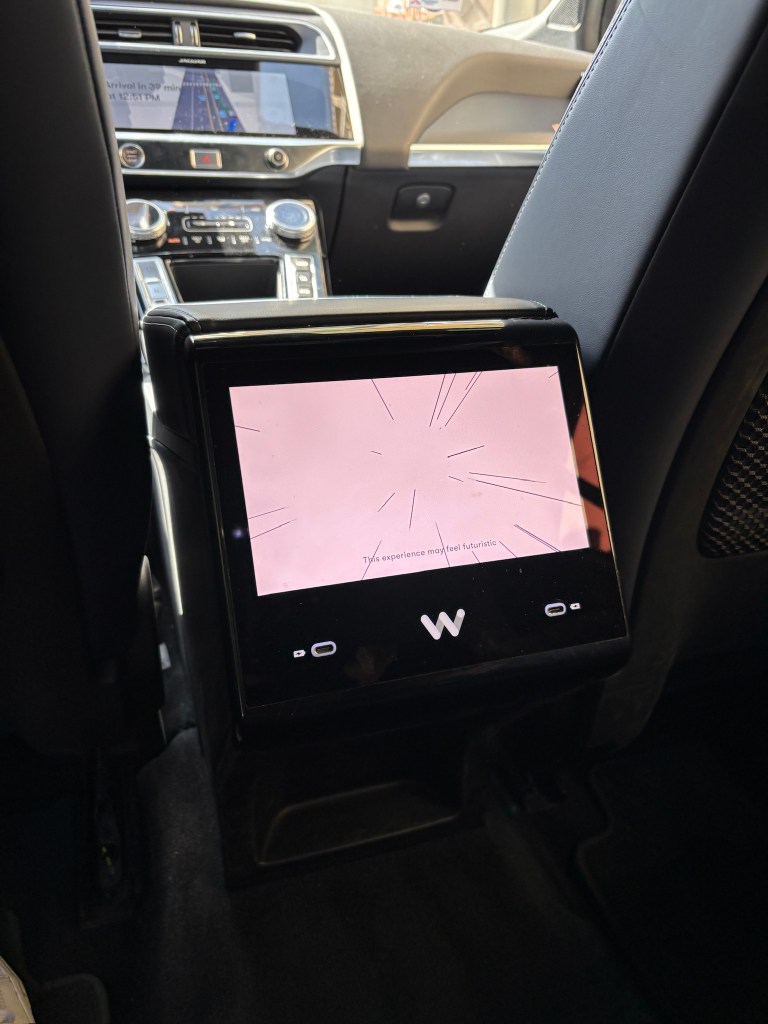
We climbed in, pushed the button to start the drive, and the Waymo started the turn signal. Click, click. Click, click. It moved into traffic. And we were on our way.
We immediately noticed something obvious: this car was driving itself. Definite Captain Obvious statement.
It took us about ninety seconds to forget that.
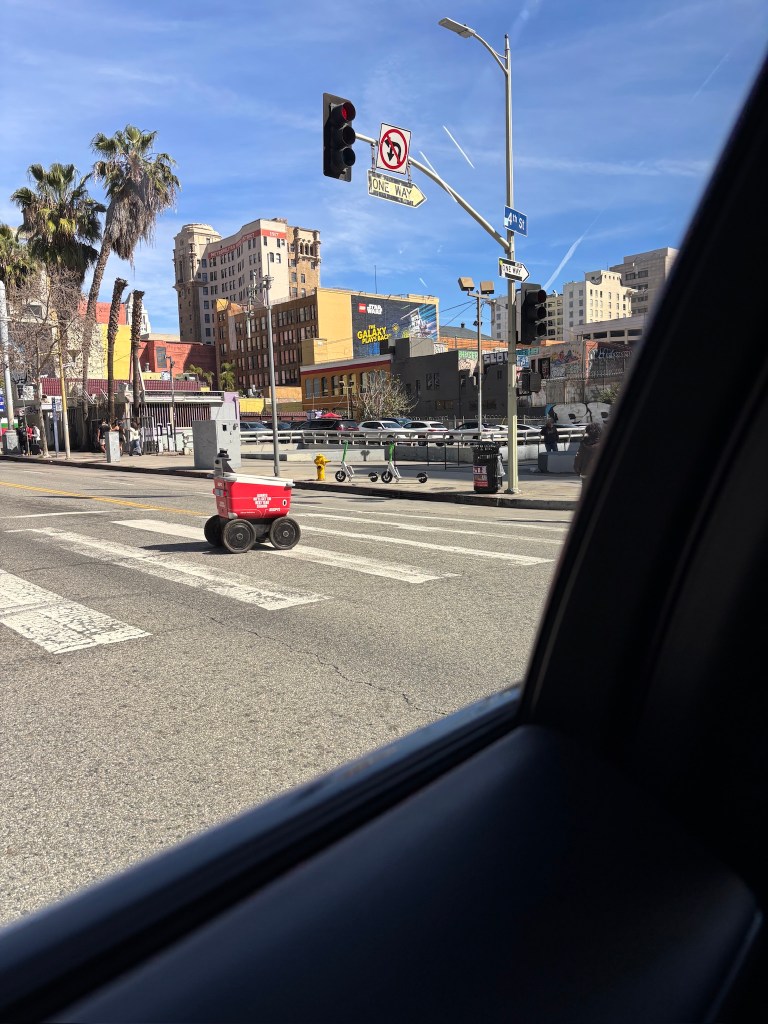
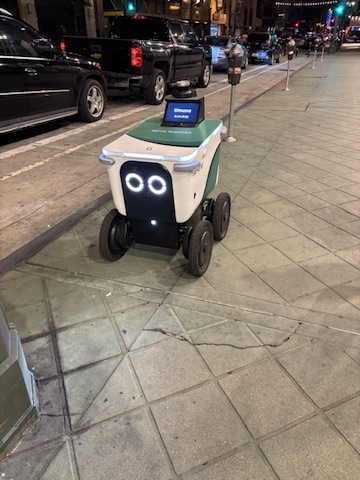
We pulled up to a red light to take a left turn. When the light turned green, the car (a robot) waited for a food delivery robot to cross the street. A robot waiting for a robot wasn’t lost on us in that moment.
After marveling at what had just happened, we started chatting, and we completely forgot there wasn’t a human driver. We enjoyed the freedom to converse without the mediation of another human. It took less than ninety seconds to forget our fears – and to forget the novelty of it all.
However, we didn’t forget our wonder and our curiosity. As we came into a log-jam, a situation that would have been difficult for a human to navigate, the Waymo snuck around the car in front of us, threading a needle between it and a car parked on the side of the street with ease. It was the third time we said, “Okay, good move.” Earlier it yellow-lighted into a smooth stop where I noted that Waymo drove like me, honoring PA yellow lights, as compared to my husband, who loves the Jersey yellow. In other words, Waymo stopped at the yellow light rather than trying to beat it, and it did so with more finesse than I would have.
Then, ahead of us, there was another robot car. The street was narrow, a side residential street lined on both sides with parked cars. The Waymo in front of us approached. It was a robot game of chicken. The two cars somehow knew which one would yield, and it maneuvered into an open hole in the line of parked cars, just enough for us to drive past.
We immediately saw a human driven car in front of us. Who would yield this time, we wondered? The human lost the game of chicken.
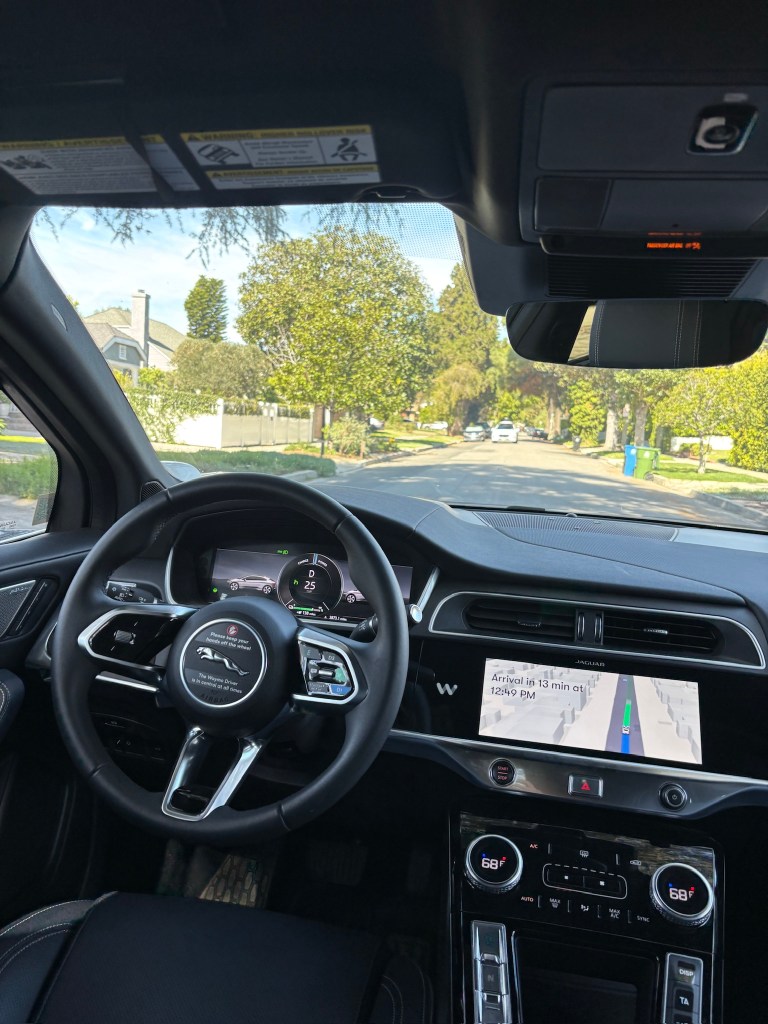
We marveled at the technology, and we realized something about ourselves: we are practicing what we preach.
We encounter a technology that makes us uncomfortable. So what do we do?
We jump in.
We push buttons. We poke things. We explore. We try it. That’s how we learn. That’s what we encourage teachers to do. That’s what we allow students to do.
We learn by inhabiting the discomfort.
Overall, we liked the Waymo. We felt less anxious overall riding in a Waymo than we do in a normal rideshare. We hypothesized that it was because we did not have to worry about interacting with an unknown human; rather, we just existed. We took the ride and enjoyed the process.
Despite that, some discomforts remained. We asked some of these questions during our ride:
- How do these cars get recharged? What’s the community impact of charging stations? Who bears that infrastructure cost?
- And what about the loss of the human driver? That’s real. That’s economic and social displacement.
There was also the more immediate fear lurking at the back of our minds: Would Bud be able to get his luggage out of the trunk before the car drove away?
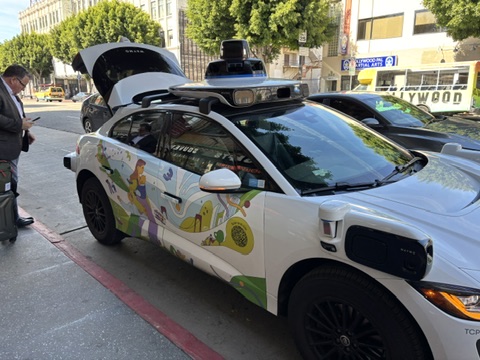
After a 30-minute ride, we arrived on Hollywood Boulevard and hi-fived for conquering the Waymo. We were proud of stepping in and experimenting, and we are just a little smarter about the world because of our experience.
And yes, Bud got his luggage. In fact, the robot car opened the trunk for him as it said goodbye and thanked us for riding.
 Filling Time: TwinLife Empty-Nesting
Leave a comment