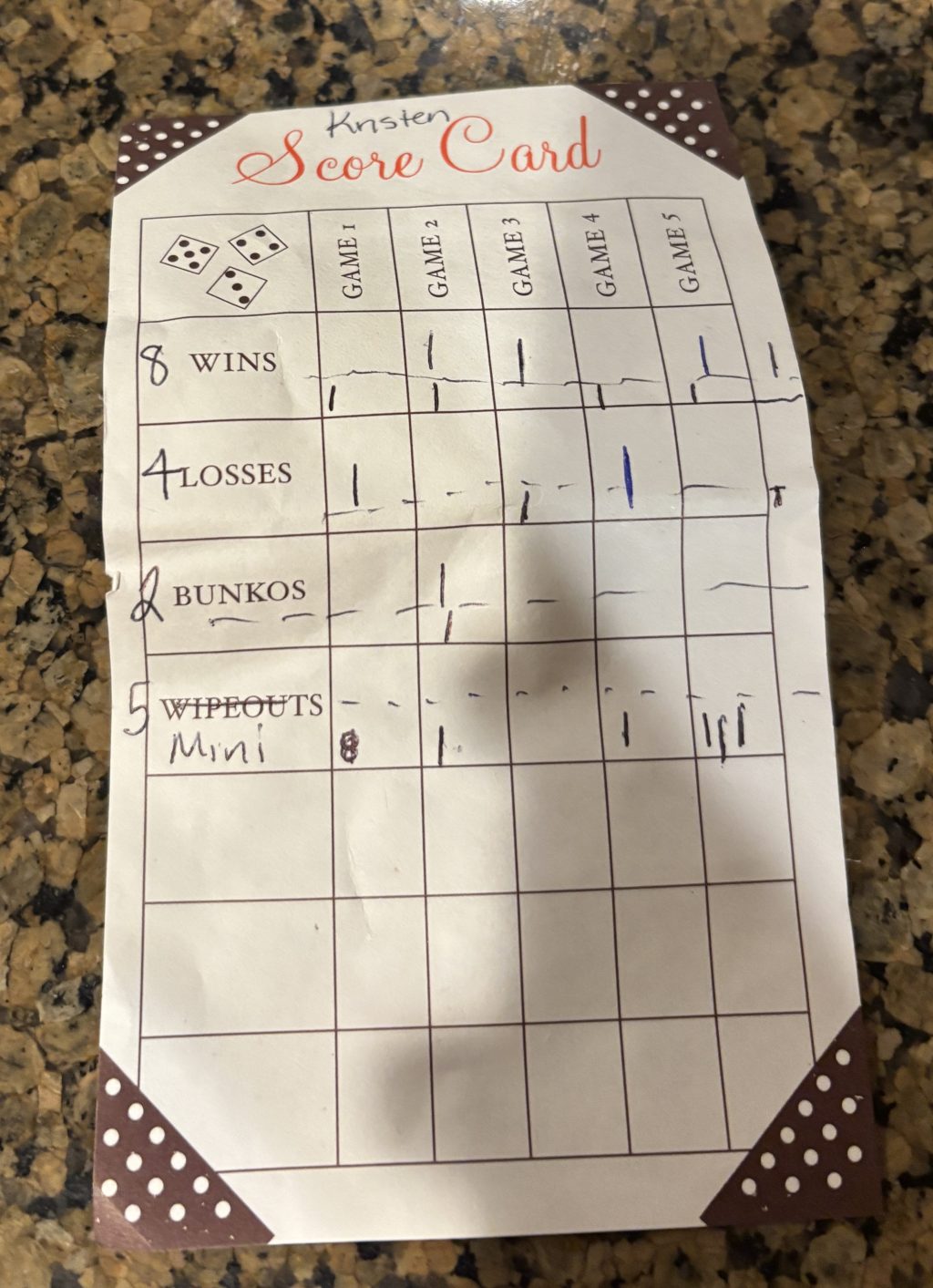
When a friend who I haven’t seen in a while invited me for coffee, I said yes. Somewhere between the invitation and the event, coffee became Bunco. I had never played before. In fact, I knew nothing about it. But, I said yes. After all, it’s my year of saying yes.
Because my friend asked me to and also because I wanted to, I arrived early to help set up. I wanted a few moments with her before the rest of the women arrived. In those moments, I learned so much about my friend that had been lost in weeks, months, and possibly even years where we didn’t connect like we should have. She is one of my people. We just hadn’t made time.
As everyone else began to arrive, I listened to conversation among women who knew each other and somehow knew the cadence of a language I’ve never quite mastered. I was transported back to the days right after I moved to New Jersey.
I never wrote that story.
Maybe I should have.
When I first moved from central PA to NJ, I often felt like everyone else had received detailed instructions to a game I wasn’t actually invited to play. There seemed to be an established culture, an established way of being, an established set of relationships. Everyone knew where they belonged, and I wasn’t quite sure where I fit.
That’s how my first night of Bunco felt.
Part of the evening was spent learning the rules. For those who have never played, Bunco is remarkably simple. You sit in pairs and roll dice, hoping to match the number assigned to the round. There is literally no strategy involved. You simply roll when it’s your turn. After each round, people switch partners and move tables. By the end of the night, you’ve played with and against nearly everyone in the room. That’s the coolest part of the game – and what I would later realize is the beauty of it.
Though I didn’t know how to play, my friend told me what to do. “Just roll,” she said. So I did. I didn’t roll a single 1 during the round 1, and I felt terrible. My team lost, which wasn’t a great start for a competitive athlete and game player. I mean, I’ve only lost approximately one game of Rummikub since I started playing it with my in-laws almost three decades ago. I like to win! I slogged from table 1 to table 3, wondering if I would be the laughing stock of Bunco. And then, during round 2, I rolled a Bunco on my first try.
For those of you who don’t know, it’s like rolling a Yahtzee. But with three dice. So it’s basically rolling three of a kind. If you are at Table 1, it matters a lot because it ends the round. If you aren’t, it matters for your score but nobody other than those at your table even know you did it. I know; this is confusing. But to spell it all out – it didn’t matter all that much and nobody among the other 11 women present really cared that I rolled a Bunco even though it was the highest I could score in the game, and I personally thought I had just rolled the equivalent of a Yahtzee. My table mates congratulated me, but in the grand scheme of the game night, it was just another roll.
Despite the grand-scheme-of-things letdown of my first best roll of the night (I had two Buncos by the end, which was the most of anyone), over the course of the night, people congratulated me when I rolled well. Rolling well basically meant I randomly rolled the number of the round in multiple dice or in multiple rolls, and, to be honest, each time someone clapped or said something positive, I was confused. The problem, as I saw it, was that I hadn’t actually done anything other than throw dice on the table. Success seemed entirely disconnected from effort (or brain power), so each cheer and congratulation felt slightly out of proportion to what had just happened. I found myself wondering why we were celebrating outcomes that nobody had actually invested thought into making.
When someone rolled a 1, 2, and 3 and jokingly asked whether she got anything extra for that combination, without thinking, I responded, “That’s another game.” Everyone laughed, and we moved on. A little while later, someone else asked a similar question, and once again I found myself saying, “That’s another game.”
By the third time I heard those words come out of my mouth, I realized my brain had been trying to redesign Bunco into another game from the moment I started playing.
The other game, of course, was Yahtzee.
My mom introduced Yahtzee to my children years ago. She even created a dry-erase score board for them and gave them giant lawn dice so that a table game became a lawn game. The game has been a staple at family gatherings, and over the years I’ve come to appreciate that Yahtzee asks just enough of its players. Every roll presents a choice. Do you take the guaranteed points or risk them for something bigger? Do you play conservatively or chase the long shot? Grappling with these questions and sometimes regretting the choice are part of the fun of Yahtzee.
These questions don’t surface in Bunco. There is literally no choice, no decision — no brain power — needed.
As I sat there rolling dice, I found myself wondering whether Bunco might be improved with just a few more decisions, like Yahtzee. But the longer I played, the more I realized that Yahtzee wasn’t really the game I was looking for. It was a great game for my kiddos, but what I was actually wanting from the people around the table was a rowdy game of pinochle.
I learned pinochle alongside my Nana, a first-gen American, and my mom and my uncle, who learned from their parents. It was a family affair that included laughter – so much laughter – and catch phrases (“piss and moan, piss and moan, and throw ’em in!”) and strategic thinking.
I’ve spent most of my life looking for pinochle partners. Not just people who know the rules, but people who play the way my family played. Around our table, the game was never just a game. It was conversation and competition, memory and partnership. You paid attention. You remembered what had already been played (unless you were my dad, and then you just threw a card and hoped for the best). You learned to anticipate your partner’s thinking (and I mastered my dad’s thinking, which is why we were pinochle champions time and again!). The social part and the intellectual part were never separated from one another. The conversation was social, but there was always something cognitive happening beneath it.
Pinochle rewards observation, memory, planning, communication, and strategic thinking. In many immigrant and working-class communities, like the ones where my Nana and her children grew up, these were valued skills. I inherited this mindset because I inherited a game that taught it.
Maybe that’s why I spent so much of the first half of the evening last week trying to understand Bunco. Not because there was anything wrong with the game, but because I was looking for something different.
At some point I stopped looking for that something in the game, which allowed me to listen more carefully to the women around me. One woman mentioned that she had almost stayed home because she had something scheduled every night that week and was exhausted, but “Robin” had convinced her to come. Later, I heard one woman tell another, “I hardly ever see you.”
Those comments stayed with me. These women clearly knew one another. Some of them lived on the same street. They shared history, routines, stories, and friendships built over years. And yet, they still needed Bunco to see each other.
It was only then that I realized I had been asking the wrong question. I had spent the evening trying to understand why they played Bunco. The more interesting question was why they kept showing up.
Maybe they weren’t looking for the same thing I was. They weren’t looking for intellectual stimulation. I came looking for a game, but they came to connect with people. By the end of the evening, I understood the gathering, even if I still yearned for a bit more strategy in the game. I’m still searching for the kind of get together that asks people to think as well as laugh – and perhaps also just BE– together. I think that kind of table is how I want to fill my time.


Leave a Reply