people+curiosity+purpose+movement+a little unpredictability and occasionally absolutely nothing

The kids went back to school, and my husband and I drove over 1000 miles and climbed a lot of stairs last weekend. We returned to a quiet house.

But this week’s post is not going to be about that. Instead, it’s a time to stop and reflect on one year of FillingTime. To do that, I’m merging my personal and professional identities and bringing AI into the conversation. I will admit that I’ve been experimenting with AI throughout this year of FillingTime, just as I have in my professional life. I do not think I could have published weekly for a year without AI. Let me explain…

I started writing TwinLife: Having It All in order to work through my feelings, struggles, and celebrations during my life as a mother of twins who worked outside the home in a pretty demanding job. It was a way to stay engaged with my inner, personal writing self while I was pursuing tenure. I did not want to lose my voice while I was focused on publishing professionally. 

But writing is hard, and my time and energy was limited as I focused on my job and my kids. So I only wrote on TwinLife when I had something to say. It became a space for me to emote when needed, not one I curated regularly. 

This past year of writing FillingTime was different. I challenged myself to write weekly, and it forced me to look at my week (and reflect through my camera roll) on a regular basis. I needed to find something to say, which sometimes forced me to curate my empty time and sometimes left me wondering at the end of the week what was worth emoting.

There were weeks where I faced the blank screen and just wrote, posting nearly first draft pieces like I did when I was writing TwinLife. There were weeks when I didn’t have the focus, nor did I have the energy to write my way through it (as I do in my professional writing). In those moments, with my self-imposed deadline looming, I’d talk it out like I used to do with my mom when I was struggling to write – except now I used Voice Memo. Whether I was driving home from work, making dinner, or sitting in the hot tub, I could turn on the recorder and just talk through my week. Then with a click of a button or two, I could grab the transcript and drop it into AI.

AI would take my transcript, which came in a single, very long paragraph, and break it into a clean paragraph form that I could read and reflect on. If my thoughts had coherence, I copied the clean version of my spoken words and started editing. If I was a little all over the place, I used AI as a thinking partner to help me find a thread worth writing about. 

Every once in a while, I asked AI to generate a full draft based on my initial input. I never used that draft. It was always crap and never really me. In fact, in one conversation with ChatGPT, where I tried repeatedly to get it to edit its output to be something I found acceptable, I told it that it was crap. It agreed with me and told me my blog was much stronger when I drafted. It was right.

I’ve had fun playing with AI through this writing process, and recently, I’ve been bringing multiple AI chatbots into conversation with each other. I ask one or more for feedback on my writing, and then I give the feedback to the other one to see what it says. I feel like I have my own personal writing group, and to be honest, it’s making my writing better. 

All this to say, I’ve been writing for a year, and I thought it would be useful to pause this week and see how my writing partners thought I should start filling my time based on everything I have posted on FillingTime. AI is particularly good at thematic analysis, so I asked ChatGPT, Claude, and Gemini to analyze FillingTime.org. Importantly, I told them not to use any of the chat history in their analysis and to focus only on the blog itself. I asked for the output to include a description of the author and recommendations for how this person could fill their time.

Gemini’s response came quickest, but it was the most superficial. It didn’t teach me anything I hadn’t already considered. ChatGPT and Claude (which took the longest in its analysis) gave me different insights, some of them overlapping and some of them distinct. I used them as thinking partners, feeding them each other’s responses and asking them to incorporate ideas that could enhance their own analysis.

By the time I was done, I had a pretty clear picture of where I might go in this next year of FillingTime.

First, here is Claude’s final analysis.
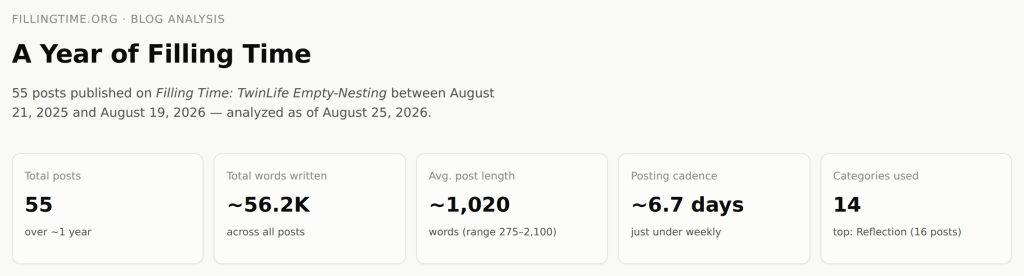
FILLINGTIME.ORG · BLOG ANALYSIS
A Year of Filling Time
55 posts published on Filling Time: TwinLife Empty-Nesting between August 21, 2025 and August 19, 2026 — analyzed as of August 25, 2026.

Stat tiles
Total posts: 55 — over ~1 year
Total words written: ~56.2K — across all posts
Avg. post length: ~1,020 — words (range 275–2,100)
Posting cadence: ~6.7 days — just under weekly
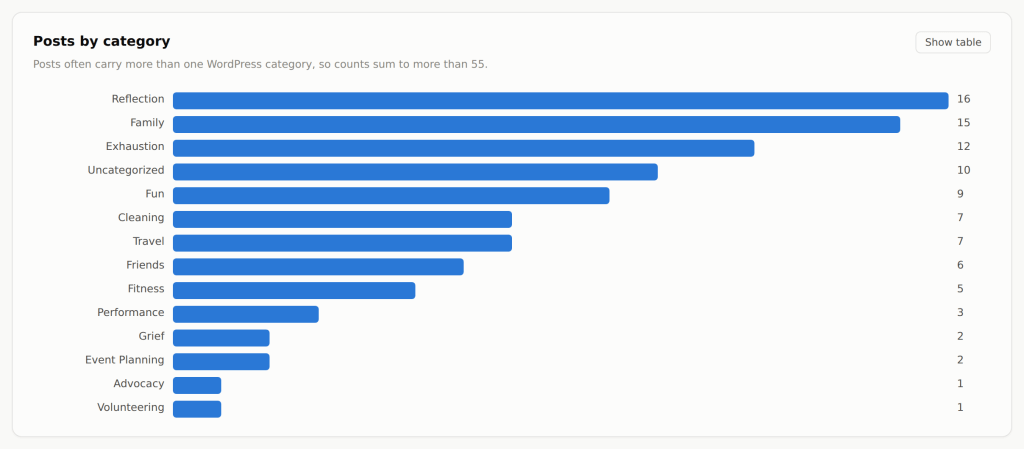
Categories used: 14 — top: Reflection (16 posts)
Chart 1 — Posts by category
Title: Posts by category
Subtitle: Posts often carry more than one WordPress category, so counts sum to more than 55.

Reflection — 16
Family — 15
Exhaustion — 12
Uncategorized — 10
Fun — 9
Cleaning — 7
Travel — 7
Friends — 6
Fitness — 5
Performance — 3
Grief — 2
Event Planning — 2
Advocacy — 1
Volunteering — 1
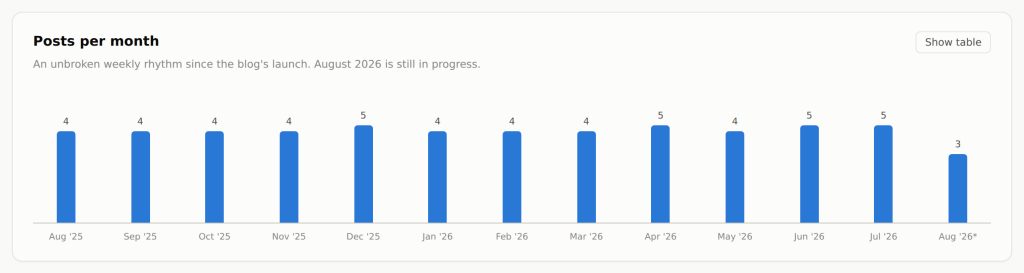
Chart 2 — Posts per month
Title: Posts per month
Subtitle: An unbroken weekly rhythm since the blog's launch. August 2026 is still in progress.

Aug '25 — 4
Sep '25 — 4
Oct '25 — 4
Nov '25 — 4
Dec '25 — 5
Jan '26 — 4
Feb '26 — 4
Mar '26 — 4
Apr '26 — 5
May '26 — 4
Jun '26 — 5
Jul '26 — 5
Aug '26* — 3
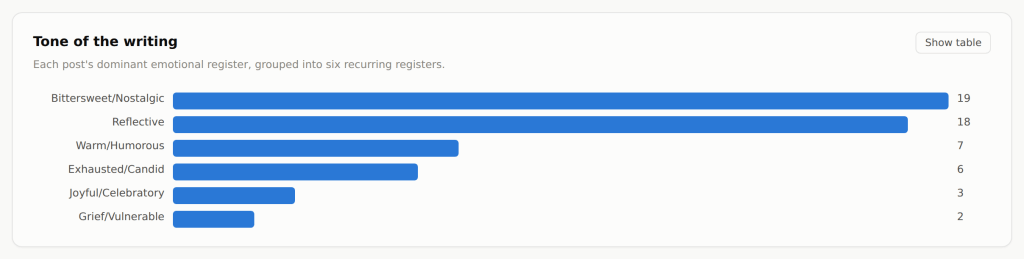
Chart 3 — Tone of the writing
Title: Tone of the writing
Subtitle: Each post's dominant emotional register, grouped into six recurring registers.

Bittersweet/Nostalgic — 19
Reflective — 18
Warm/Humorous — 7
Exhausted/Candid — 6
Joyful/Celebratory — 3
Grief/Vulnerable — 2
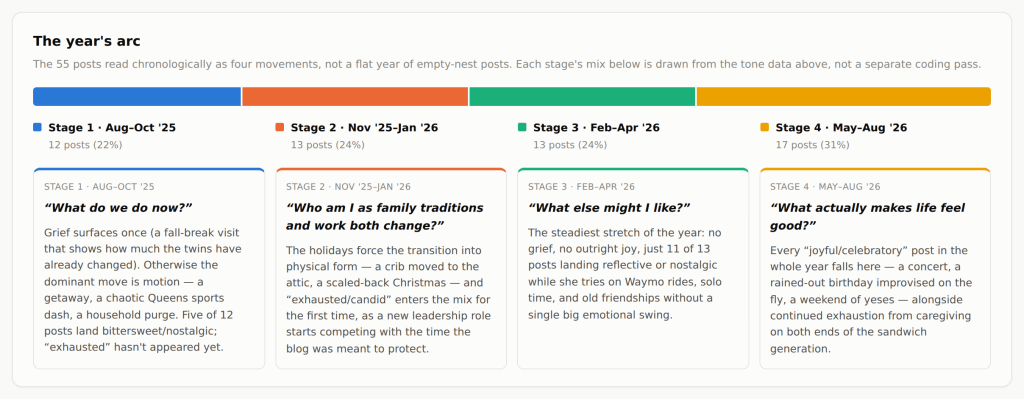
Chart 4 — The year's arc
Title: The year's arc
Subtitle: The 55 posts read chronologically as four movements, not a flat year of empty-nest posts. Each stage's mix below is drawn from the tone data above, not a separate coding pass.

Stage 1 · Aug–Oct '25 — 12 posts (22%)
"What do we do now?"
Grief surfaces once (a fall-break visit that shows how much the twins have already changed). Otherwise the dominant move is motion — a getaway, a chaotic Queens sports dash, a household purge. Five of 12 posts land bittersweet/nostalgic; "exhausted" hasn't appeared yet.

Stage 2 · Nov '25–Jan '26 — 13 posts (24%)
"Who am I as family traditions and work both change?"
The holidays force the transition into physical form — a crib moved to the attic, a scaled-back Christmas — and "exhausted/candid" enters the mix for the first time, as a new leadership role starts competing with the time the blog was meant to protect.

Stage 3 · Feb–Apr '26 — 13 posts (24%)
"What else might I like?"
The steadiest stretch of the year: no grief, no outright joy, just 11 of 13 posts landing reflective or nostalgic while she tries on Waymo rides, solo time, and old friendships without a single big emotional swing.

Stage 4 · May–Aug '26 — 17 posts (31%)
"What actually makes life feel good?"
Every "joyful/celebratory" post in the whole year falls here — a concert, a rained-out birthday improvised on the fly, a weekend of yeses — alongside continued exhaustion from caregiving on both ends of the sandwich generation.
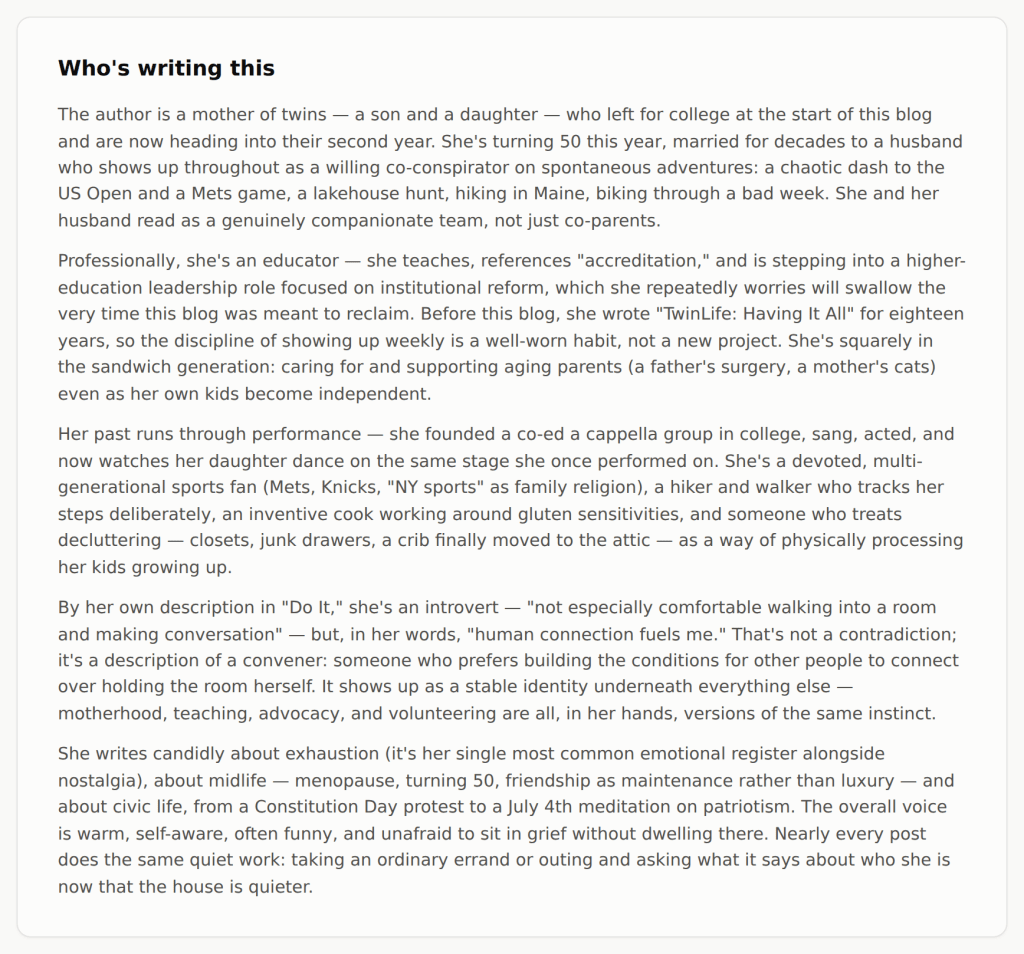
"Who's writing this"
The author is a mother of twins — a son and a daughter — who left for college at the start of this blog and are now heading into their second year. She's turning 50 this year, married for decades to a husband who shows up throughout as a willing co-conspirator on spontaneous adventures: a chaotic dash to the US Open and a Mets game, a lakehouse hunt, hiking in Maine, biking through a bad week. She and her husband read as a genuinely companionate team, not just co-parents.

Professionally, she's an educator — she teaches, references "accreditation," and is stepping into a higher-education leadership role focused on institutional reform, which she repeatedly worries will swallow the very time this blog was meant to reclaim. Before this blog, she wrote "TwinLife: Having It All" for eighteen years, so the discipline of showing up weekly is a well-worn habit, not a new project. She's squarely in the sandwich generation: caring for and supporting aging parents (a father's surgery, a mother's cats) even as her own kids become independent.

Her past runs through performance — she founded a co-ed a cappella group in college, sang, acted, and now watches her daughter dance on the same stage she once performed on. She's a devoted, multi-generational sports fan (Mets, Knicks, "NY sports" as family religion), a hiker and walker who tracks her steps deliberately, an inventive cook working around gluten sensitivities, and someone who treats decluttering — closets, junk drawers, a crib finally moved to the attic — as a way of physically processing her kids growing up.

By her own description in "Do It," she's an introvert — "not especially comfortable walking into a room and making conversation" — but, in her words, "human connection fuels me." That's not a contradiction; it's a description of a convener: someone who prefers building the conditions for other people to connect over holding the room herself. It shows up as a stable identity underneath everything else — motherhood, teaching, advocacy, and volunteering are all, in her hands, versions of the same instinct.

She writes candidly about exhaustion (it's her single most common emotional register alongside nostalgia), about midlife — menopause, turning 50, friendship as maintenance rather than luxury — and about civic life, from a Constitution Day protest to a July 4th meditation on patriotism. The overall voice is warm, self-aware, often funny, and unafraid to sit in grief without dwelling there. Nearly every post does the same quiet work: taking an ordinary errand or outing and asking what it says about who she is now that the house is quieter.
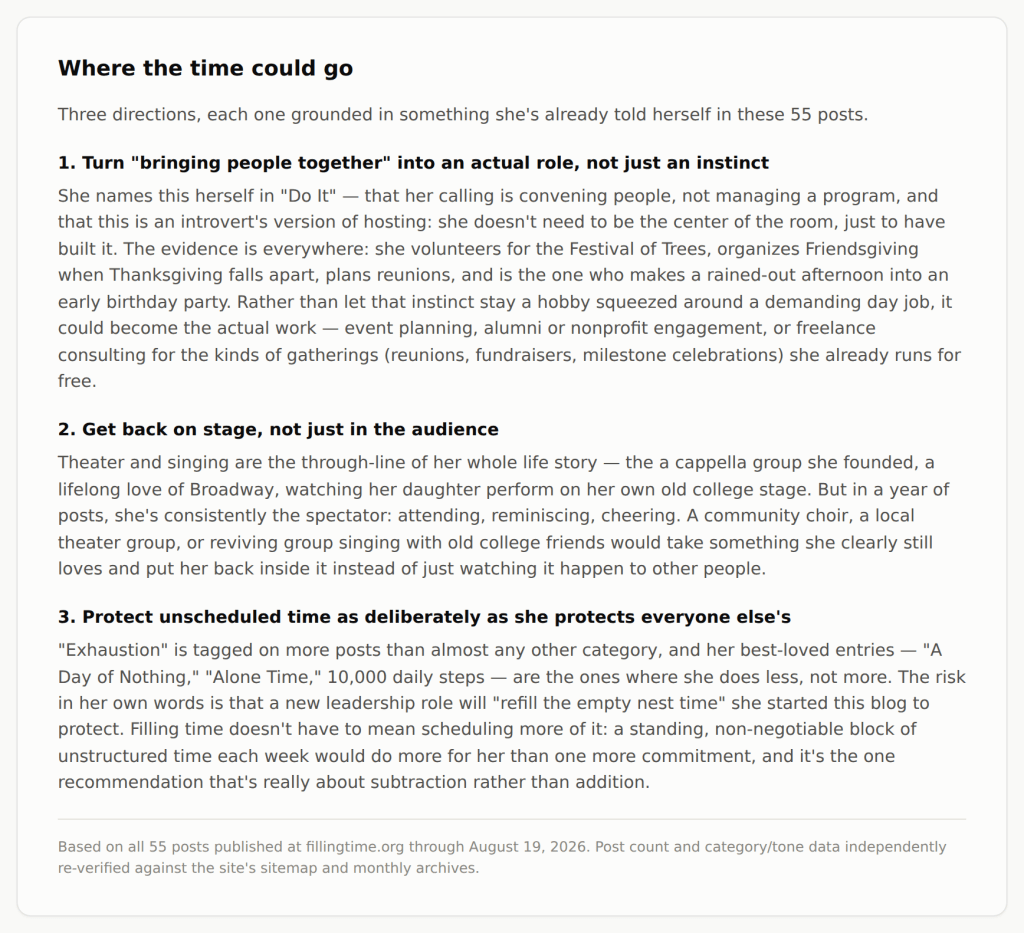
"Where the time could go"
Three directions, each one grounded in something she's already told herself in these 55 posts.

1. Turn "bringing people together" into an actual role, not just an instinct
She names this herself in "Do It" — that her calling is convening people, not managing a program, and that this is an introvert's version of hosting: she doesn't need to be the center of the room, just to have built it. The evidence is everywhere: she volunteers for the Festival of Trees, organizes Friendsgiving when Thanksgiving falls apart, plans reunions, and is the one who makes a rained-out afternoon into an early birthday party. Rather than let that instinct stay a hobby squeezed around a demanding day job, it could become the actual work — event planning, alumni or nonprofit engagement, or freelance consulting for the kinds of gatherings (reunions, fundraisers, milestone celebrations) she already runs for free.

2. Get back on stage, not just in the audience
Theater and singing are the through-line of her whole life story — the a cappella group she founded, a lifelong love of Broadway, watching her daughter perform on her own old college stage. But in a year of posts, she's consistently the spectator: attending, reminiscing, cheering. A community choir, a local theater group, or reviving group singing with old college friends would take something she clearly still loves and put her back inside it instead of just watching it happen to other people.

3. Protect unscheduled time as deliberately as she protects everyone else's
"Exhaustion" is tagged on more posts than almost any other category, and her best-loved entries — "A Day of Nothing," "Alone Time," 10,000 daily steps — are the ones where she does less, not more. The risk in her own words is that a new leadership role will "refill the empty nest time" she started this blog to protect. Filling time doesn't have to mean scheduling more of it: a standing, non-negotiable block of unstructured time each week would do more for her than one more commitment, and it's the one recommendation that's really about subtraction rather than addition.

I particularly liked the way Claude characterized my husband’s and my partnership of being “co-conspirator[s] on spontaneous adventures” and a “companionate team.” Like Chat, Claude thinks I should convene, create, and protect unscheduled time.

ChatGPT’s executive summary complements Claude’s more detailed report and gets to the heart of the recommendations for FillingTime.
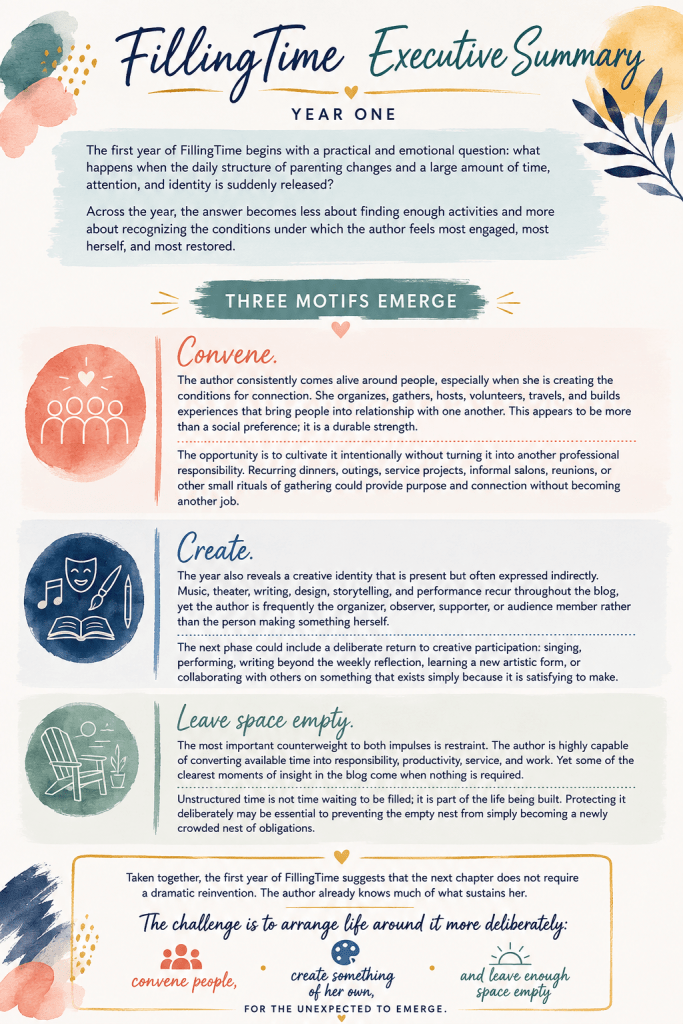
The first year of *FillingTime* begins with a practical and emotional question: what happens when the daily structure of parenting changes and a large amount of time, attention, and identity is suddenly released? Across the year, the answer becomes less about finding enough activities and more about recognizing the conditions under which the author feels most engaged, most herself, and most restored.

Three motifs emerge.

**Convene.** The author consistently comes alive around people, especially when she is creating the conditions for connection. She organizes, gathers, hosts, volunteers, travels, and builds experiences that bring people into relationship with one another. This appears to be more than a social preference; it is a durable strength. The opportunity is to cultivate it intentionally without turning it into another professional responsibility. Recurring dinners, outings, service projects, informal salons, reunions, or other small rituals of gathering could provide purpose and connection without becoming another job.

**Create.** The year also reveals a creative identity that is present but often expressed indirectly. Music, theater, writing, design, storytelling, and performance recur throughout the blog, yet the author is frequently the organizer, observer, supporter, or audience member rather than the person making something herself. The next phase could include a deliberate return to creative participation: singing, performing, writing beyond the weekly reflection, learning a new artistic form, or collaborating with others on something that exists simply because it is satisfying to make.

**Leave space empty.** The most important counterweight to both impulses is restraint. The author is highly capable of converting available time into responsibility, productivity, service, and work. Yet some of the clearest moments of insight in the blog come when nothing is required. Unstructured time is not time waiting to be filled; it is part of the life being built. Protecting it deliberately may be essential to preventing the empty nest from simply becoming a newly crowded nest of obligations.

Taken together, the first year of *FillingTime* suggests that the next chapter does not require a dramatic reinvention. The author already knows much of what sustains her. The challenge is to arrange life around it more deliberately: **convene people, create something of her own, and leave enough space empty for the unexpected to emerge.**

In Chat’s first analysis, it said my time this past year led to this equation:
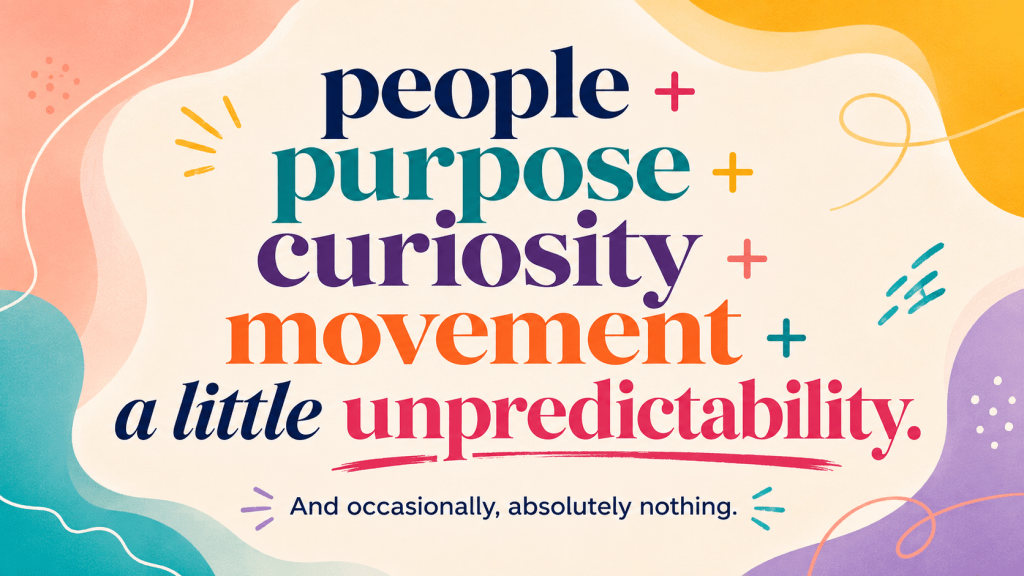
people + purpose + curiosity + movement + a little unpredictability. And occasionally absolutely nothing.

The purpose is important, I think.

One thing missing from both of the analyses is that I need to find my purpose for giving back. Volunteering has been a core part of my identity for as long as I can remember. Moving forward that purpose might be in convening women over 50 (Claude suggested I start a podcast!), but I’m not sure that’s it. During TwinLife, my life was full of volunteering. I did relatively little of it this year comparatively. I want to get back into the community and find a place, not tied to my kids, that can use my talents and skills. 

As I continue to search for that right fit, I think my AI thinking partners are correct: I need to convene, create, and give myself permission to leave space empty. I’m already working on the plan to fill my time!

Posted in

Leave a comment