The first week of the semester (or school year) is always incredibly hard. My brain is challenged in different ways even as my body adjusts to a new schedule. Last week was a particularly brutal one. I logged almost 50 hours of work without breaks, and that doesn’t include my commute.
Given the schedule, I needed to give myself permission to take a week off from FillingTime.
So I broke the streak.
For more than a year, I have written something here every week. Sometimes I knew exactly what I wanted to say. Sometimes I sat down without much of an idea and discovered it through the writing. The commitment to write weekly gave me a reason to pay attention to how I was filling my time and what I was learning about my new role as an empty-nester. Somewhere along the way, the commitment to write became a streak, or perhaps more accurately, a forced habit. It is time to shift the purpose.
A few weeks ago, I asked AI to analyze the first year of FillingTime. I wanted to know what patterns it saw across all of my posts. It identified three recurring ideas: convene, create, and leave space. I found the analysis surprisingly useful. AI didn’t uncover some secret about me that I didn’t know, but through its analysis of my words, it revealed who I am and what I’m seeking. The recommendations felt right.
And so I made some decisions. I joined a choir, and I signed up for a yoga class. Both are limited-time commitments, which is intentional. I don’t know yet whether I want to fill my time with structured, weekly commitments, but I’m testing them. The choir brings music back into my life on a regular basis, and yoga asks me to leave space in my head, which I need.
I am going to try them and notice what happens, and I think I need to make a similar commitment to test something in my writing. Weekly discipline got me here with a 55-post weekly streak. It made me write when I would not have otherwise. It made me take notice of things, especially small things, and to find humor in my world. But I don’t want to be locked into weekly writing. I want to write purposefully.
This week, something happened that made me want to write: My co-teacher told our students about his friend Paul.
A week after Paul landed his dream job, a plane crashed into his floor of the World Trade Center. Paul, a good natured man, natural observer, and simply amazing human, arrived early to work. He always did. He died on September 11, 2001, and my colleague and the friends who knew Paul made a commitment after his death: every year, during the week of September 11, they would tell Paul’s story.
Twenty-five years later, they still do, and this year, our students became part of the circle of people who now know Paul.
As I listened to Paul’s story, I thought about something I had written several years ago. At the time, I was coordinating a writing and healing group for teachers. We were writing about collective trauma in our teaching contexts, and when I began my own reflection, three moments emerged immediately for me: Columbine, September 11, and the sudden death of my student Pam.
Responding to the prompt “I was there the day after…”, I wrote:
I was there the day after Columbine, when fear coursed through the school and Code C drills became normal.
I was there the day after 9/11, when Mary’s seat stayed empty and field trips became something of the past.
I was there the day after Pam died, when we sat together in disbelief and grace became just a little more present.
In each case, I remembered the same thing about being a teacher in the aftermath of something tragic. My students and I shared collective grief, and we needed to heal together and separately. The writing group surfaced the feelings, and eventually, my initial writing became a more polished piece about September 11.
Shattered Innocence on September 11
On the morning of September 11, 2001, I rose early, drove 45 minutes to school, arriving between 6:30 and 7:00AM, plenty of time before the 8:00 bell, and started the day prepping, planning, and grading. It was just like any other day.
I taught in a school with block scheduling, and it was a B day, my “easy” day with only two classes. First period lasted from 8:05 – 9:34, and I have no idea what we did during that time. I’m sure it was a neatly planned combination of mini-lesson, individual and small group work, reading and writing – the basics of any of my lessons in English class. I’m sure it was an Academy class, a college-level class for a magnet school housed at the public high school, because after that period, I walked down from the Academy building to the main building for my prep/duty periods. As I approached the corner door, I passed Keri, my Academy teaching partner, who looked dazed, and perhaps even frightened.
“What’s wrong?” I instinctively asked her.
“Planes hit the World Trade Centers. I was watching up in the media room. You should go up there.”
I was confused, but I followed her advice. I popped into the media studio, a tiny room that housed a few TVs, joining about ten colleagues already there, eyes riveted to the screen. Other teachers came in behind me, the news quickly spreading through the school. Quietly, those in the room, those in the know, filled us in on what had happened while we were blissfully teaching our first period classes. As the whispers whipped around the room with questions, speculations, incredulity, someone cried out, “I think it’s falling!”
What? Were my eyes deceiving me? The screens were so small. Could it be real?
The tower fell, and my stomach sank. How many people were in that building? Was my father-in-law in that building? Were my students’ family members in that building?
After I watched the second tower fall from the media room, I ran to the attendance office, the only place where there was a phone where I could make an outside call. I connected briefly with my husband, who did not know if my father-in-law had gone to the city that day. At the time, during his phased retirement, he was traveling to the World Trade Center less and less frequently. My husband felt confident that he would not have been in the tower.
I had a feeling of dread. As I walked down the hall, headed back to my classroom on the hill, the building moved in slow motion. Faces of incredulity stared, searching eyes making contact, unanswered questions lingering in the air as we passed in the corridors. As news spread through classrooms and parents began calling the school or simply showing up to collect their children, the community braced for the unknown to come.
In my last block class, the room of 14-year-olds looked to me to lead them. They had questions, of course, and we would not have answers for quite some time. I knew, however, that their innocence was shattered that day.
And that is what I realize when I look back. Our innocence was shattered on 9/11. The titanic shift in the world that would come as a result of the terrorist attacks similarly rocked our school community. Field trips were cancelled, and ever after justified first by examining the safety of students in light of potential threats. Teaching and learning took place in a new context, one where war was fought on US soil, not somewhere far away. Students began debating issues like the constitutionality of the Patriot Act, and Muslim students felt hatred that they had not before experienced.
In some ways, I don’t think our community has fully healed, as the prejudices seeded that day have grown.
Twenty years after September 11 – a date that does not need a year to bring visceral feelings – I reflect on the day when time stood still. It took a while for me to heal. My family had a good ending, as my father-in-law, who actually had been in the tower and had been entering the concourse when the first plane hit, finally came home. Mary’s uncle did not, and her sadness filled our classroom and her writing for the entire year. The juxtaposition of our stories was omnipresent for me. In her story I saw what could have been mine – and so many others in our school community who feared for loved ones that day. In her story I saw the stories of so many students who also did not have a happy ending. It was creating a space for these stories to be shared that helped me to heal, and hopefully, helped my students as well.
When I reread the piece now, I’m struck by the importance of stories. Embedded in my short reflection are so many personal stories of that day: Mary’s, my father-in-law’s, my husband’s, my own. Surrounding it are all the stories of others who were impacted that day and beyond.
September 11 is all over my social media feeds and on my streaming platforms as we approach the 25th anniversary. One rabbit hole led me to BOATLIFT, An Untold Tale of 9/11 Resilience.
The stories of the boats is one I hadn’t heard, but it resonated with me, especially because it’s how my father-in-law got out of Manhattan. I’m sharing it because it’s important to carry stories forward, to not let them disappear. My colleague keeps Paul alive by telling his story, and it matters.
I didn’t write last week because I didn’t have anything left to give to writing. Forcing myself to produce a post simply because another week had passed would have missed the point of what FillingTime has taught me.
This week, I am writing because a story reminded me of another story, and because something I wrote years ago suddenly had a reason to be read again. So perhaps breaking the streak helped me decide why I want to write in this second year of FillingTime.
The weekly practice served me well. I suspect I will still write most weeks. But I’m giving myself permission now to leave the space empty when I need to—and to fill it when there is something I believe is worth carrying forward.
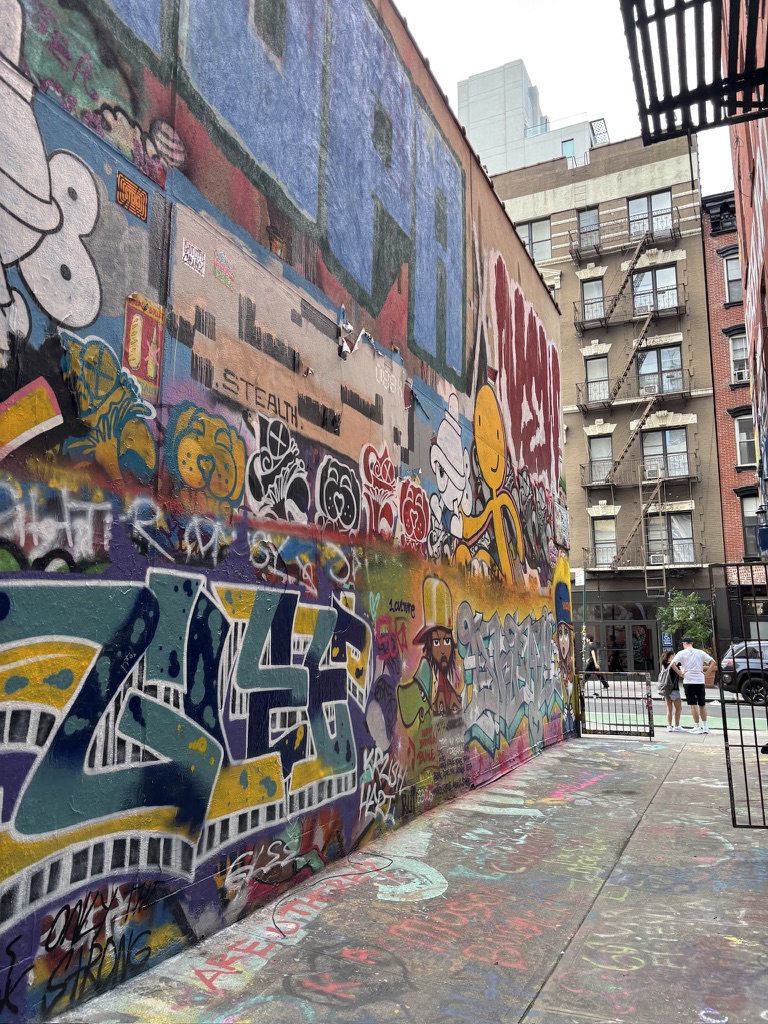
One of my very long days last week included a trip into lower Manhattan, where I stumbled across this alley of beautiful art. It feels right to share it in this post.
 Filling Time: TwinLife Empty-Nesting
Leave a comment