I have steaks sitting at home defrosted in the fridge. I took them out of the freezer over the weekend, not accurately calculating my time this week to cook them. I also defrosted chicken, which I did turn into a pretty mean gluten-free chicken and broccoli last night while I was on a video call about the marketing of my new book. I scarfed down a plate of it (seriously, I thought it was delicious) before hopping on a webinar for my university. My week has been almost as hectic as my first week of the semester. I am currently sitting in a hotel outside of DC on a 24-hour business trip.
Gluten-free cooking has its challenges (hence the reason I was impressed with my chicken and broccoli, which rivaled any restaurant-style I’ve ever had), but gluten-free travelling is almost always a challenge. Two years ago I stayed in this same hotel, attending the same conference. I did not expect to have many options to eat, because then, when I searched Find Me Gluten Free (my favorite travel app), I had basically one good restaurant choice near the hotel, and a Whole Foods about a 10-minute walk away.
When I arrived today, I checked the app and was pleasantly surprised. Not only were there 4-5 restaurants within a few block radius, I realized a Whole Foods had opened last year on the back side of the hotel. With Whole Foods as a backup, I started perusing menus.
Something non-gf people probably don’t realize is that getting an order of fries is a luxury for those of us who are celiac/sensitive. I love fries. I rarely can have them because they are fried in a fryer where gluten-containing items are also fried. Cross-contamination is a real thing. So as I searched for a walkable restaurant, I looked for one with fries I could eat.
I found a grill that said it had celiac-safe fries, which immediately got my attention. The place featured burgers (which I don’t like) that could be subbed for a chicken breast. Doable in order to get my fries. But then I looked more closely at the menu and saw that I could order a steak.
My mind immediately went to the defrosted steaks in my fridge at home. Could I really order a steak when I would need to cook the ones I had taken out of the freezer in the next few days?
I was halfway to the restaurant, enjoying the afternoon sunshine, when I made my decision. I wanted the steak.
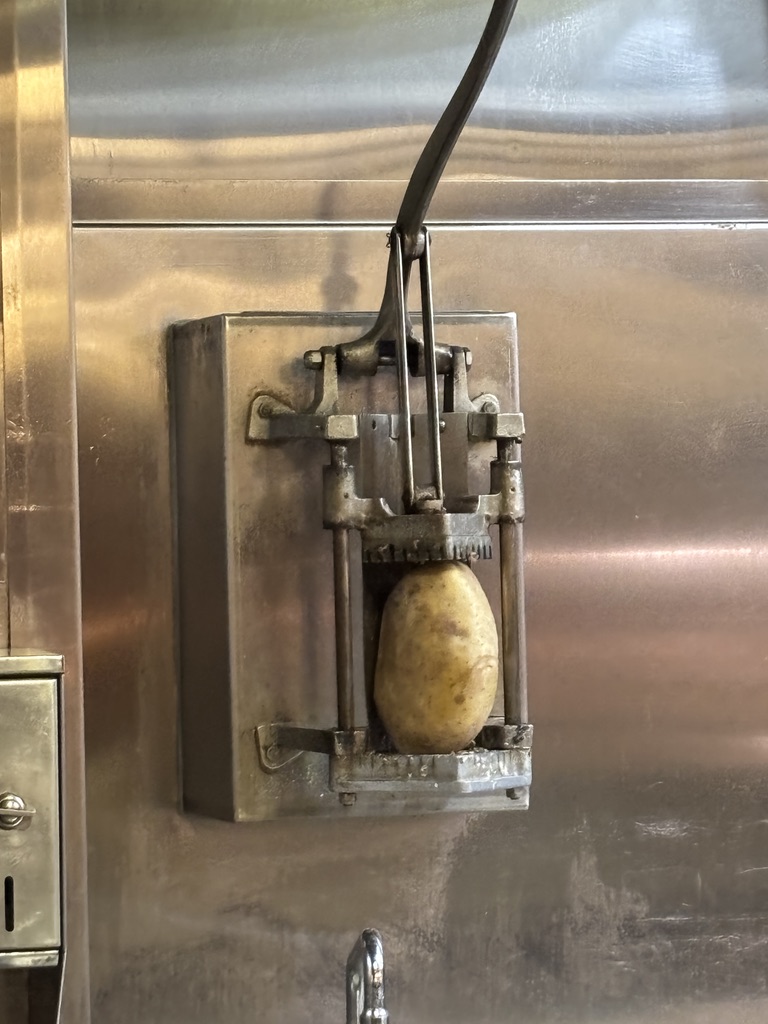
I also wanted to make sure I could eat the fries, which was my whole purpose for going to that restaurant. As soon as I entered, at the 5-PM empty-hour, I chatted with the host and the manager about the fries. They assured me they were safe, bragging about their 3-fryer system, and I assured them I was ready to eat at their restaurant. They told me it was happy hour at the bar so I found a seat — by myself — and I ordered a happy hour margarita, a steak, and the fries. As I waited, I noticed the 3-fryer system that had been described to me, as well as a fresh potato slicer just in front of me. I felt safe. I felt good as I indulged my cravings, sitting alone there at the bar.
It was kind of awesome.
Of course, I had engineered the awesomeness of sitting at that bar alone, basking in my professional accomplishments.
I was there because the next morning, my university was receiving an award.
We were among the institutions that earned a completely clean accreditation review: no stipulations and no areas for improvement. Only 32 institutions received that distinction this year, and my university was one of them. That alone means something to me.
When I started my job almost ten years ago, I knew almost immediately that I had to fix the education program if we were going to get through accreditation. I had 18 months to do it. Luckily, I was able to hire a faculty member (even before my contract started), and I picked a gem. Nancy had skills and chutzpah that are rare. Because the accrediting body (and for me, the state in which I was getting accreditation) was new, we both had a lot to learn. But we embraced the challenge, dug in, and trusted each other out of the gate.
I quickly learned that we had an enormous amount of work to do. Six months into my job, I attended the accreditation conference, the same one I am attending tomorrow.
I showed up pretty naively, and by the second hour had taken pages of notes. By the end of the day, I had filled my legal pad. That night, I was awakened by a fire alarm, and as I evacuated, the first thing I grabbed wasn’t my wallet or even my phone. It was my legal pad of notes. I knew that the future of the program was dependent upon my understanding of what we needed to do to earn accreditation.
Eighteen months after I started my job, we submitted the self-study of our programs that would ultimately be approved for accreditation. Nancy and I took a program that absolutely would have failed and passed with only two areas for improvement and no stipulations (big red flags that portend doom!). Out of five categories upon which we were evaluated, we only had two that were flagged for improvement, and those two were related to things largely outside the program. Basically, they were out of our control.
Nancy and I had fixed what we could fix, and I implemented departmental systems that would help us to continue our improvement. Then I spent the next five years trying to fix the rest, including the university structures that had led to the areas that our accreditor had identified as needing improvement.
I was a dog with a bone.
Over that time, people at the university changed. Rules changed. Structures changed. Education was something of a stepchild, sitting in the graduate school while much of the university’s attention was understandably focused on the undergraduate college. Trying to build the systems we needed for accreditation was an uphill battle. But gradually, we did it.
We used accreditation to push the university on data collection. We built systems within our programs that had never existed before. We created processes for looking at evidence, asking questions about what we were doing, making changes and then looking again.
When our latest accreditation review came back completely clean, I knew we had accomplished something. As soon as I knew we had a clean review, I also knew we would be recognized with recognition given to all programs that had the same accomplishment. I had seen it presented at the two conferences I had attended previously, and, quite frankly, I was chasing the prestige of being on that short list.
What I didn’t know was that we were also going to receive another award. Our university was recognized as a standout program that sought and achieved continuous improvement using data to make decisions. Among all the institutions accredited by the organization, our small university (and even smaller program) was awarded the highest honor.
When I got the email notification, my first thought was, “I’m not in Education anymore. I’m not even working with these programs. I have this whole other job and this whole other thing I’m building. I cannot attend this conference to accept this award.” I dismissed the possibility of attending.
But then someone from the organization reached out and asked whether anyone was coming to accept the award. If so, they said, they would love for us to present about the work we had done. That was when I started looking more carefully at what we had actually won. I realized that we were not just receiving the standard recognition, but that we were being truly recognized. I felt like someone should go to the conference and present our work.
But, there was literally nobody at the university who could make the presentation besides me – because it was truly my work that needed to be shared. And that realization led to an understanding that is somewhat uncomfortable for me to write:
That’s not actually my university’s award. It’s actually my award.
Except it isn’t. It belongs to my university. It belongs to the Education programs. And it absolutely belongs to the team of people who did this work with me. But I am proud of it, as a team member and as the team leader.
My final slide tomorrow is a picture of the four of us who became the inquiry team behind much of the work that is being recognized. We all worked. We listened to each other. We questioned, pushed back, and collaborated. We allowed ourselves to be guided by whoever’s expertise mattered in the moment, and we trusted each other. But I can’t erase myself from the story in the name of humility.
I led the work. I chose every single one of the team members, and I chose well. I could not have done this without them, and I built the team. I implemented systems that had not existed in the department, the programs and, ultimately, parts of the university. I kept pushing when people changed and structures changed and it would have been much easier to accept that this was simply something the university wasn’t particularly good at. I could have been okay with another round of areas for improvement and continued to work on those areas. But I wanted our program to be great, our university to be great.
So, yes, the award goes to the university.
But. My team won this award.
And I know I get to claim it too. Once I realized that, I decided I wanted to be at the conference to accept it.
The problem was money. I knew the university did not allocate funds to send me—or anyone else—to this conference. So though I wanted to attend, I had to make a decision of whether I would fund my own travel. Here comes the problem solving!
- Get the organization to waive the conference fee. (Check)
- Find the cheapest means of travel for a day trip. (Check)
- Ask for reimbursement of the train ticket from the university. (Check)
My original plan was impressively efficient. Take the train to the conference (3+ hours). Accept the award at the 8 a.m. opening session. Present immediately afterward. Get back on the train. Go home.
This plan checked a lot of boxes. I wouldn’t miss teaching my afternoon class the night before the conference. I wouldn’t ask my university to pay for a hotel. I wouldn’t cost anyone very much of anything. (The train ticket totaled a bit more than $100).
And then I started thinking:
Well, that’s a lot on me.
And I needed a break. So I decided to take a train after my class and spend the money to stay in the hotel myself. Paying for the hotel would ultimately make it easier on me – physically and mentally.
Then I realized that teaching an extended block in the afternoon and trying to get to a train station 40 minutes away on a tight schedule would cause me angst. So I arranged for someone else to teach my class in order to make it easier on me.
With those two concessions made, I stopped thinking about it. I had done what I could do to make it easier on me. So my plan in the morning was to work from my husband’s office, across the street from the train station, until my evening train, booked well before I decided to cover my class. Though I had looked to change trains, I realized that an earlier departure would cost more money.
As we commuted, my husband said, “You are going to get in pretty late. Why did you schedule it that way?” I answered honestly – it was the cheapest. I was not looking forward to the late arrival, especially because I knew eating at a late hour would be difficult. But until he asked the question, I was not considering my well being. And then I started to reflect. The start of the semester has been intense. Taking the kids back to school took more out of me than I expected. Work has been relentless. I was tired.
So the first thing I did when I opened my computer (while at my husband’s office) was to see how much an earlier train ticket would cost. It was $36.
$36 dollars would allow me to stop worrying about how I would eat gluten-free between my husband’s office and my hotel bed. I had already paid for my hotel room, so why wouldn’t I spend $36 dollars on my peace of mind? After all, I considered this trip more about my ego than I did about my university (who could advertise the award regardless of my attendance to receive it in person). I booked the earlier train.
After I checked into my hotel and decided to go to the restaurant with the fries, I bumped into a woman I met when I first started at my university. In our state, she is hailed as the queen of accreditation. She has volunteered in her retirement to help the accrediting organization – and our programs in our state.
I shook her hand and told her that she had helped me all those years ago and that our small program was getting an award. She told me she was getting the volunteer award. Both an individual and a very small program from our state being recognized at a national conference – as I chatted with her, the timing of all of this felt right.
I’m leaving this part of my professional life. In many ways, I’ve already left it. I’m doing something new now, something that asks me to think differently about education and about what I want the next part of my career to look like. But maybe before I could completely move into that work, I needed to pause and recognize the work I’ve done in this last chapter.
Almost a decade ago, as I attended this conference, overwhelmed and insecure, I grabbed my accreditation notes instead of my wallet during a fire drill because I had suddenly realized the magnitude of what I needed to do. This year, I will walk into the same conference and accept an award for what my colleagues and I created, despite all odds.
I know my university would not be receiving this award without me. And I also know that I wouldn’t be accepting it without my team.
I think I needed to be here to let myself acknowledge that.
I did it. I did what I could do. Now I need to move on and do something else.
This realization came as I sat alone at a bar with a margarita, celiac-safe fries and a steak. I was there at that restaurant because these are some of my favorite things. I was there in that town because I can accomplish great things. And it’s important that I recognize that as I move forward in FillingTime.


Leave a Reply