I didn’t think that filling time by sitting on the couch would be fulfilling. But after two weeks of travel, it’s what I needed. I was worn down from days spent moving from hotel rooms to sleeping on a blow up mattress at my brother’s, and after the “two planes, three trains, and an automobile” adventure to get home during a blizzard, my half-century body gave in. I got sick.
As I returned home, my son texted to say his Friday class got cancelled, and he was trying to take an earlier train home for spring break. I literally got giddy with excitement. Originally, I wasn’t really going to see him. He and my husband had planned a long-awaited spring break trip because, as a baseball player, he had not had the opportunity to really enjoy spring break during high school. He was always at the school, even while his friends (and twin sister) had time away. Even though they both pressured me to join them in their short getaway, I knew that I couldn’t. I couldn’t sneak another few days away from work after being remote for two weeks.
So I resigned myself to missing my kiddo while he had his adventure with his dad. Which is why it was so much sweeter when he said he was coming home early! Unfortunately, I got hit with a bug, which limited my capacity to “play,” but I did enjoy his presence before the two of them set off on their bonding adventure.
I was filled with multiple emotions – grateful to be in his presence when I didn’t expect it; jealous that they were headed to warmer weather and a true vacation; and an overwhelming feeling of loss, or as I expressed to them, “missing you.”
In reality, after I got past all of that, I dug into my status of “solo lady” (different from single lady, to be sure). This shift was made easier because I physically felt like crap. There’s not a lot I can say about filling time other than that I did what needed to be done, what couldn’t be put off, and what made me forget how bad I was feeling while I was sick. The couch and I became intimate. The phone and I became friends. I conquered many levels in my stupid game, and I accomplished what needed to be accomplished – and nothing more – at work.
I had alone time while also navigating what it truly means to be alone.
I’m still taking it all in and reflecting on what it means. But I think what I ultimately learned is that I need some alone time – with no commitments, no expectations, no mundane tasks, and no freezing weather. I have experienced this kind of time in my past – on the lake, in particular – and it’s becoming clearer to me what makes it all worth filling my time.
My dad texted to say that he and my mom had just seen the planets in alignment, which prompted me to get off the couch and go outside. The sky was beautiful, and the night held the kind of warmth that predicts spring is coming. It was a nice outing off the couch.
I’m sitting in an airport, filling time by reflecting on the last week. Until yesterday, I expected to write about how I filled time with my brother, going to the gym, watching Paridisus, continuing to design the thing we have been talking about for nearly two decades. I was staying with him between work events in California, and I could not fill time by enjoying the weather (it was awful), so we just filled time in each other’s presence. It was good. It was natural. It’s something I’d like more of in my future.
And then a blizzard hit the northeast, so I ended up stranded in California longer than I had anticipated. Luckily, the weather turned, so I had a day full of sun in downtown LA, which opened up new opportunities to fill time.
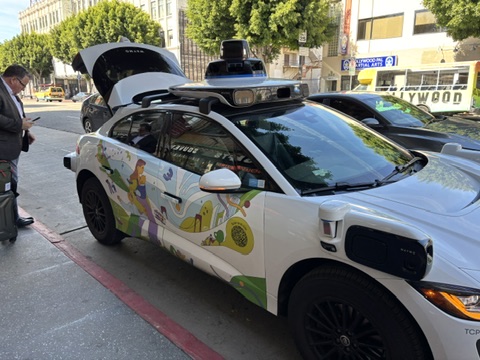
I wrote last week about the Waymo, self-driving cars that I saw everywhere in San Francisco. They both fascinated and terrified me. The fact that one of my friends found them preferable to human powered ride-shares convinced me I should try one while I was on the West Coast, but I had neither the guts nor the opportunity.
A moment to reflect on the guts part of this equation –
When I was 7, my parents took my brother and me to Sesame Place. One of the attractions was a rope jungle gym designed for climbing to the top. It was probably about 5 feet in reality, but in my mind it was the height of the Empire State building. In hindsight, it was the first time I recognized my fear of heights, which lives with me till today. In fact, after my brother dropped me off at the train station last week, I almost had a panic attack crossing to the other side of the tracks. I texted him this picture to show him where I nearly broke down – the open stairway nearly did me in.
At Sesame Place, the open ropes did me in. While my two-year-old brother climbed to the top, I froze mid-climb. My parents told me I didn’t need to go further and let me head back down – absolutely the right decision, by the way – but my failure to push past the fear has stuck with me. I never wanted fear to hold me back again. It’s why I pushed back the tears when I was stuck on the side of Seneca Rocks and climbed my way to the top when I was 17. I was not backing down again.
So, I knew that if I had the chance to ride in a robot car, despite my fear, I had to at least try it. And I knew I would have the chance on the ride from the train station to my hotel in LA. I told my brother I was going to do it. I downloaded the app. I prepared mentally.
And then when I got off the train, I faced pouring rain. The crappy California weather was giving my already tired soul another challenge, and I reverted to my comfort zone. I called an Uber.
I didn’t regret it at the moment, but I kept thinking about the robot car all weekend, especially because I was steeped in conversation about AI in education with some of my closest colleagues in the field. We are the ones who experiment with technology. We encourage others to do so. We say, “If you don’t play, you don’t know the possibilities or the limitations.” We push past our fears and jump in to do the things.
How could I possibly leave the West Coast after nearly two weeks, stranded in the middle of the rope gymnasium?
The first night, my group talked about Waymo. Only one person had done it. They loved it, just like my friend. They recommended it. They said they would go with me. A bunch of us said we would try together. The herd mentality made it easy to say “yes, I will.”
But we were tired from travel so we didn’t want to do it that night. We promised to go somewhere via Waymo the next night. That night, after we had spent all day in deep thinking and conversation about AI, we were even more tired. We could not fathom an hour round trip to see the Hollywood sign (this was our solution to where we should take the Waymo), when our beds were about four blocks away from the restaurant where we were eating. We thought about taking the Waymo back to the hotel (I mean, it couldn’t kill us in a 4-block ride, right?), but the cost didn’t seem worth the experience.
Without a gang, I gave in. But I was still thinking about the damn ropes at Sesame Place. How could I leave LA without trying the Waymo?
Luckily (yes, I’m saying that right now), a blizzard hit the East Coast, and I was stranded in LA. Also luckily, one of my friends had some extra time before his flight. He was the only member of our group to download the Waymo app besides me. I knew he was committed. We designed a plan that would allow us to take a Waymo to see the Hollywood sign and the Walk of Fame, the epitome of touring in LA, with just enough time for him to get to the airport.
The rest of this (longer than usual) post is co-written with Bud Hunt (@budtheteacher) and ChatGPT. Bud and I narrated our Waymo ride in real time, and ChatGPT took that transcript and cleaned it up, organizing our thinking just a bit. I filled in the details of the story. The main points Bud and I want to share are that (1) we saw something new, (2) we jumped in to try it, (3) we reflected on our experience AND what it might mean for society, and (4) we are somehow different because of it. I’ll leave you to ponder those points by reading our Waymo journey.
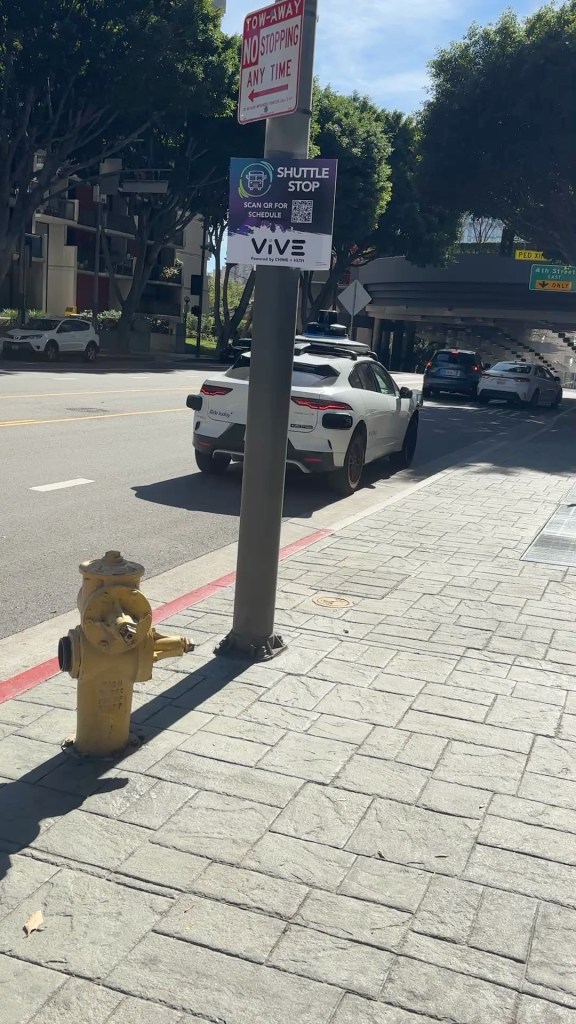
Standing in the hotel lobby, Bud called the Waymo on the app, very similar to Uber/Lyft. He looked at the map and said we need to walk to the street and turn left. He double checked a few times, zooming in on the app to verify we were in the right place. We waited, chatting amiably about our experience during the weekend. We were both just a bit nervous and also excited for this adventure. If Bud missed his flight, no problem. It was an adventure worth it. We could fail, and he would be ok.
The Waymo pulled up to the curb. Bud pushed “unlock door” in the app, and we discussed whether he should put his luggage in the trunk. Would he be able to get it back out later? I devised a plan that at the end of our ride, I would stay in the car and leave the door open until he figured out how to get his luggage. He opened the trunk manually and put his luggage inside.
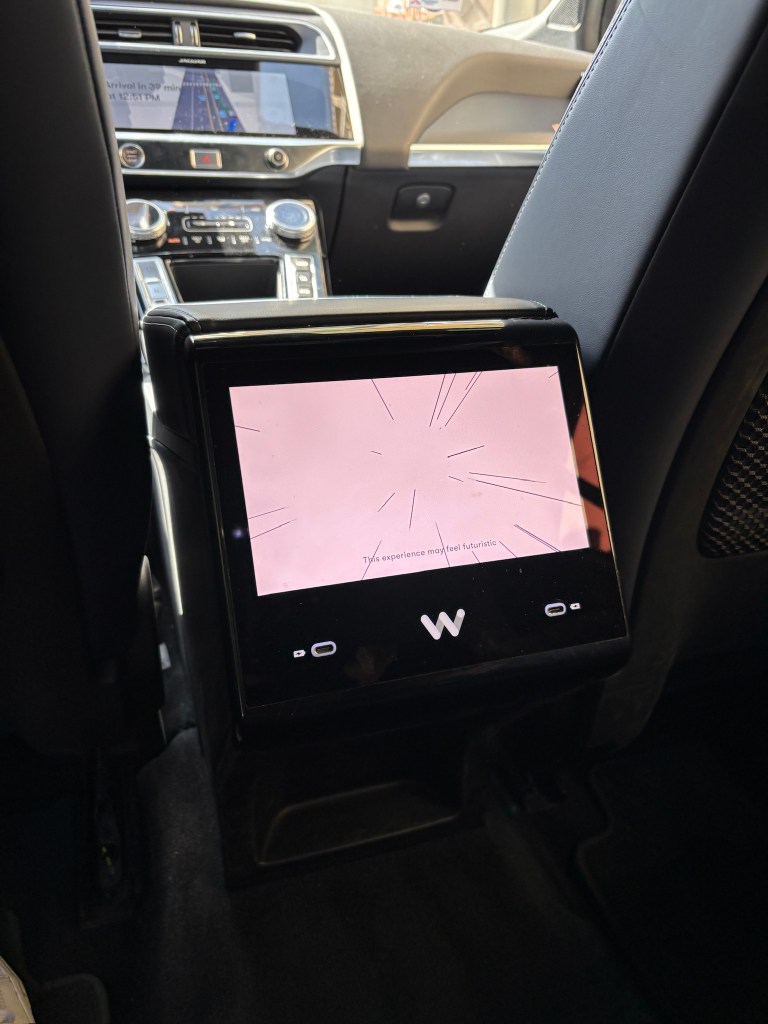
We climbed in, pushed the button to start the drive, and the Waymo started the turn signal. Click, click. Click, click. It moved into traffic. And we were on our way.
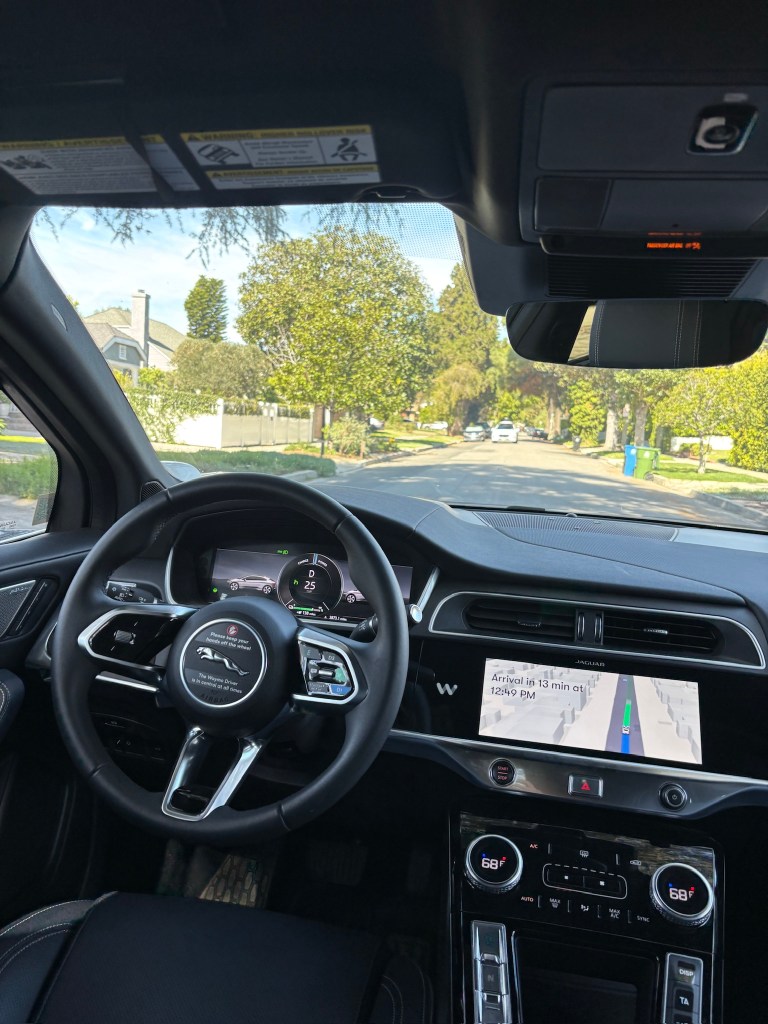
We immediately noticed something obvious: this car was driving itself. Definite Captain Obvious statement.
It took us about ninety seconds to forget that.
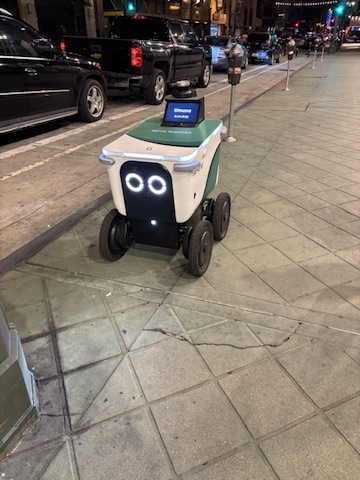
We pulled up to a red light to take a left turn. When the light turned green, the car (a robot) waited for a food delivery robot to cross the street. A robot waiting for a robot wasn’t lost on us in that moment.
After marveling at what had just happened, we started chatting, and we completely forgot there wasn’t a human driver. We enjoyed the freedom to converse without the mediation of another human. It took less than ninety seconds to forget our fears – and to forget the novelty of it all.
However, we didn’t forget our wonder and our curiosity. As we came into a log-jam, a situation that would have been difficult for a human to navigate, the Waymo snuck around the car in front of us, threading a needle between it and a car parked on the side of the street with ease. It was the third time we said, “Okay, good move.” Earlier it yellow-lighted into a smooth stop where I noted that Waymo drove like me, honoring PA yellow lights, as compared to my husband, who loves the Jersey yellow. In other words, Waymo stopped at the yellow light rather than trying to beat it, and it did so with more finesse than I would have.
Then, ahead of us, there was another robot car. The street was narrow, a side residential street lined on both sides with parked cars. The Waymo in front of us approached. It was a robot game of chicken. The two cars somehow knew which one would yield, and it maneuvered into an open hole in the line of parked cars, just enough for us to drive past.
We immediately saw a human driven car in front of us. Who would yield this time, we wondered? The human lost the game of chicken.
We marveled at the technology, and we realized something about ourselves: we are practicing what we preach.
We encounter a technology that makes us uncomfortable. So what do we do?
We jump in.
We push buttons. We poke things. We explore. We try it. That’s how we learn. That’s what we encourage teachers to do. That’s what we allow students to do.
We learn by inhabiting the discomfort.
Overall, we liked the Waymo. We felt less anxious overall riding in a Waymo than we do in a normal rideshare. We hypothesized that it was because we did not have to worry about interacting with an unknown human; rather, we just existed. We took the ride and enjoyed the process.
Despite that, some discomforts remained. We asked some of these questions during our ride:
How do these cars get recharged? What’s the community impact of charging stations? Who bears that infrastructure cost?
And what about the loss of the human driver? That’s real. That’s economic and social displacement.
There was also the more immediate fear lurking at the back of our minds: Would Bud be able to get his luggage out of the trunk before the car drove away?
After a 30-minute ride, we arrived on Hollywood Boulevard and hi-fived for conquering the Waymo. We were proud of stepping in and experimenting, and we are just a little smarter about the world because of our experience.
And yes, Bud got his luggage. In fact, the robot car opened the trunk for him as it said goodbye and thanked us for riding.
I embarked on an extended trip to the West Coast last week, perhaps blessed by two invitations to speak on two consecutive weekends in California. Because it made sense to visit my brother between visits rather than fly home, I decided to make an adventure of it. Of course, being physically away from work for so long posed challenges, somewhat easily solved by Zoom technology and understanding colleagues, but my angst about leaving was amplified when I was informed that I had to move buildings at work – NOW! – with about two working days notice before I left.
So the first part of my week was really filled with getting ready to leave. But once I arrived in San Francisco, I realized I could fill my workday with virtual work while also slowing down a bit to simply notice.
My noticing began on the ride from the airport to the city, where I saw in person for the first time a Waymo car. In fact, I saw a many during my stay, and I was fascinated. I knew about them, of course, but seeing them in action became part of my mental documentation of the trip. I watched one pull next to the curb, stop, turn on its turn signal, and wait for four other cars to pass before pulling into line. I wouldn’t have known there was nobody in the car if it hadn’t been labeled as Waymo and I hadn’t peered inside. This kind of driving was somewhat routine (though impressive), and I reflected on the first Waymo I had seen on the ride from the airport. It pulled up beside my Uber, waiting patiently at the red light. As my Uber driver extraordinaire worked his way to my hotel, I wondered whether Waymo could do what he did. Seriously, I tipped my human driver extra in cash because he was amazing at navigating city traffic efficiently while making me feel safe. Could the robot driver do that? Or would it just follow the programmed route without trying to switch lanes and work its way forward more efficiently?
This line of questioning – robots (AI) vs. human competencies – dominates my professional life, and since I was speaking at a conference about AI in education over the weekend, it’s not surprising that it dominated my time last week. In fact, the Waymo car made its way into the talk of one of the other speakers. Think about this for a minute – the taxi business was upended by Uber about 15 years ago in the city that now is being taken over by driverless cars. In other words, Uber may be out of business soon in the city where it started, less than two decades before it made taxis nearly obsolete.
Much of my time in San Francisco was pondering the effects of technological change on society – and therefore on education – but even though my work days extended into the weekend conference days, I had a lot of time to fill.
So I noticed.
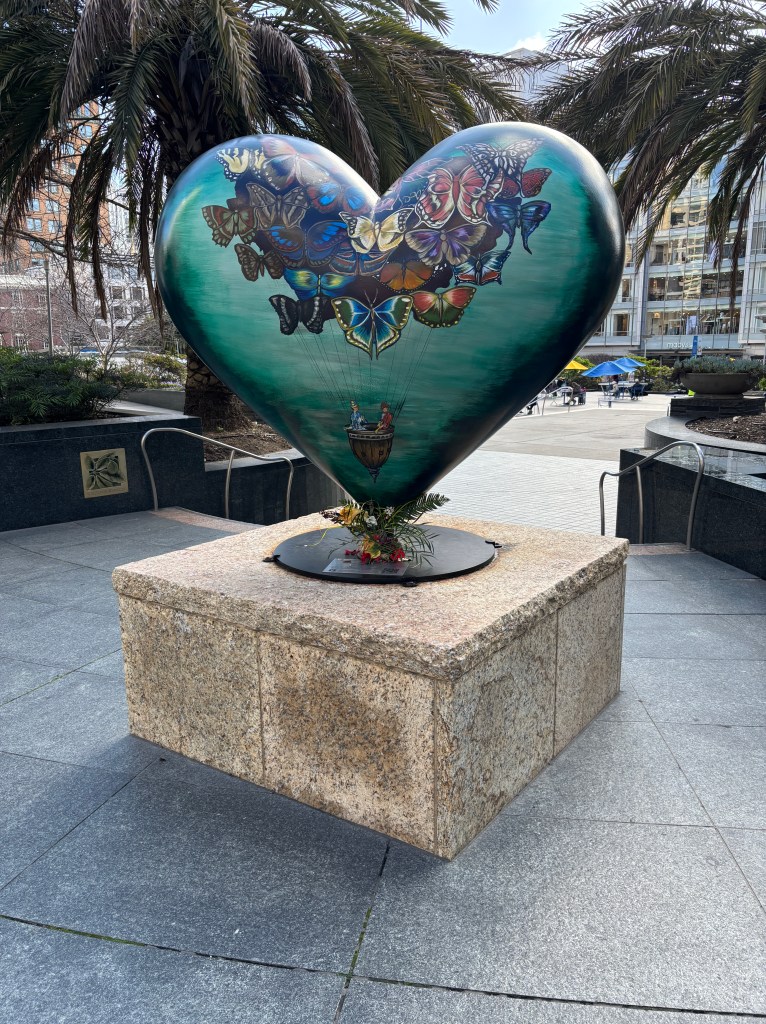
I noticed the art in the street – both commissioned and evoked.
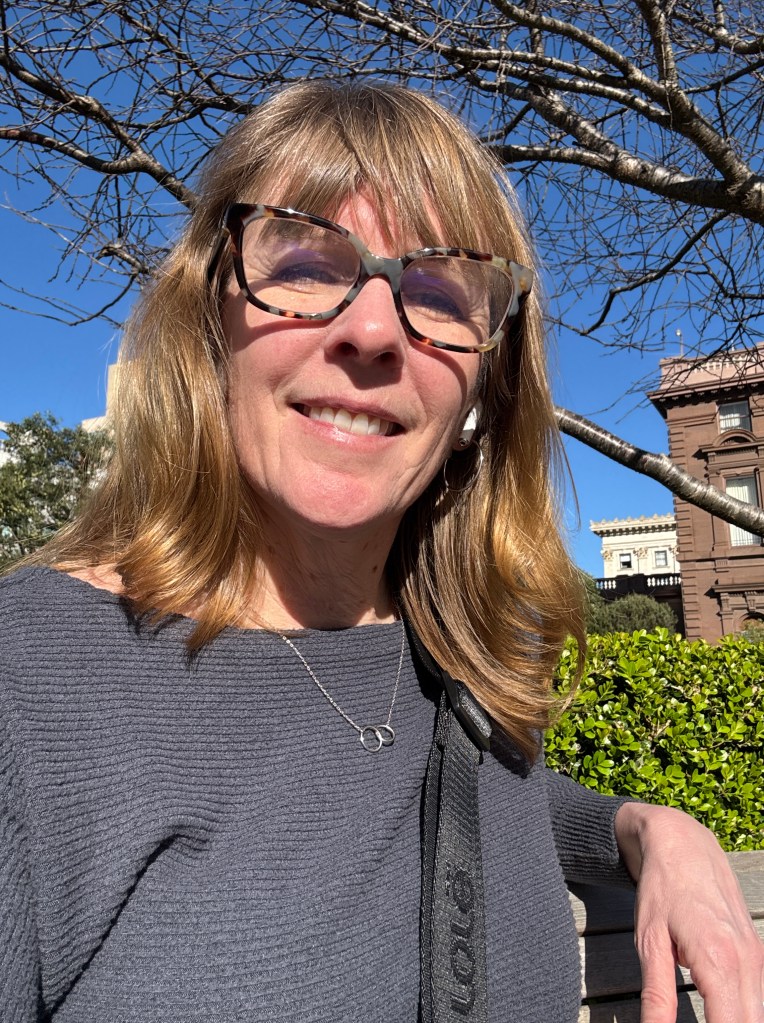
I noticed the sun, giving enough warmth for me to wander without a jacket, so unlike the Northeast this winter, and making my hair seem blonder than it is in the dreary days of winter.
I noticed the landscape with its beauty of human and natural elements.
I filled time with noticing, reflection — AND still somehow committed to my goal of (re)connecting with women from my past, present, and hopefully, future.
Perhaps ironically, I had dinner with my first friend (literally, we met when I was 2ish), who actually doesn’t live in San Francisco but happened to be there on business, and I had breakfast with a relatively new friend, who lives outside the city and whom I’ve found through my professional network but has become more than just a professional colleague to me. At both of these shared meals, I ended up reflecting on my project of filling time. How do I want to fill time is a question that is linked to what fulfills me as an individual – especially if it’s not about my kids and not about my profession. One of my two friends has a clear answer to that. She has for years. She owns who she is and she leans into the thing(s) that make her whole outside of work. I admire her. The other friend was less sure, and she helped me to realize that I’m on a journey that may continue for quite some time. I admire her too.
My friends help me reflect on myself, and for now, I realize that in the mean(filling)time, I’m committed to noticing – because that practice may help me to figure out what fills my time in the future.
My Nana loved baseball. When I visited her house as a child, the sounds of the Baltimore Orioles filled the air, sometimes coming from the TV, but more often than not from her small, portable radio with its big black dials. At night the voices of the announcers, full of static, lulled me to sleep as I stared at a shrine of Orioles memorabilia on the shelf in the guest room. A signed baseball, a pennant, an orange and black pom-pom, and a Cabbage Patch doll in a Baltimore uniform all testified to the fact that my Nana was a true fan. She loved the Orioles and her “sons” (as my mom called them), Rick Dempsey and Cal Ripken, and she also loved the game.
Because my parents did not follow professional sports, it was Nana who took me to my first baseball game, where the nine-year-old in me sat, bored by the rain delay and the incessant “removal and replacement of the tarp” on the field. That game ended after several interminable hours in an unimpressive 1-0 score, and it would be nearly two decades until I attended another game. My personal apathy, however, never deterred Nana from talking to me about baseball, and I learned a lot from her that eventually led to my watching Cal Ripken, Jr. break Lou Gherig’s record for consecutive games played with my college boyfriend. A few years later I married that boy, and I became a Mets fan by association.
My husband adopted the Mets in the 1980s, the heyday of Keith Hernandez, Ron Darling, and a slew of other great players. Like my Nana, my husband was (and is) a true fan – of the team and also of the game. I often joke that anyone who is a Mets fan is actually a true baseball fan; you must love the sport to be disappointed year after year after year and still come back to cheer the team (IYKYK).
I joined the club in the mid-2000s when another round of great players made it fun to watch the game. Wright, Reyes, Beltran, and Delgado kept me company during a summer of bedrest at the beginning of TwinLife, and even though the Mets ended in an incredible collapse that year, I crossed over into true fandom. My son is now carrying the torch, and watching the Mets is a family affair. My husband and I even trekked into Queens to see a game during our very first weekend of FillingTime as empty-nesters.
Because we are fans, when I learned that Gary, Keith and Ron, the great announcers for the Mets, would be speaking in our area, I bought tickets. I figured it would be a great way to fill time. And it was.
For a little over an hour, we listened to them share stories about the Mets. Their lives as Mets players and announcers paralleled my husband’s fandom, as well as my own. We laughed at their sibling-like relationship, reminisced alongside them, and I even teared up a bit when they described moments – like Santana’s no hitter – that were important in my family’s history. They were honest, down-to-earth, and joyful, and it made being an insufferable Mets fan simply Amazin’.
I know that the Mets will be part of FillingTime for years to come. I’m sure my Nana is smiling down at me. I know she would be pleased I turned into a baseball fan, and I know she would be elated that I root against the Yankees — just like she did!
I am a bicentennial baby, so this is my year of 50, and in January I decided that part of how I would honor it was by intentionally cultivating female friendships outside of my work life. Each month, I want to mark this year not just by celebrating the number, but by deepening connections with women who know me, challenge me, and make room for honesty.
There’s a lot to be said about the “76” of it all, the reasons to celebrate, and the reasons to relish in the ideals of the founders. That’s not my purpose in celebrating my 50th, but it is worth thinking about as I intentionally make connections this year. After all, the ideals of my homeland are about honoring the humanity of every person. Though the origins of the country did not live up to that ideal, the documents that lay the foundation also allow for us to grow into it. We cannot grow into the ideal if we don’t make connections with others.
So, for my 50th, I want to embrace the ideal and make connections, specifically with women, as this has always been a challenge point for me. Perhaps more to come on this topic – but I didn’t have an easy childhood or adolescence, mostly because — people can be (perhaps are inclined to be) mean. So this year, as part of filling time, I want to cultivate friendships with females who are in my orbit.
Last week, I had dinner with a friend I’ve known for years but had never actually shared a one-on-one dinner with. It was lovely in the truest sense of the word. We made each other think. We laughed. We talked about our kids, but more importantly, we talked about ourselves: who we are as women, how our identities have shifted, what it means to carry careers, ambition, and selfhood at this stage of life. I told her about my “year of 50” intention and thanked her for helping me kick it off.
At one point she said, “At this age, we just have to cut through the bullshit. There’s no time for it anymore.” Her honesty landed. I’ve been navigating female-relationship-bullshit my entire life. As I turn the corner on 50, there’s no time for it anymore.
Years ago, a friend told me that when she became an empty nester, she decided to be deliberate about the friendships she cultivated. I’ve carried that idea with me for a while. Now, in my year of 50, I want to put it into practice. I want to choose connection with purpose, honesty without performance, and relationships that make room for my whole, evolving self.
This year, I’m celebrating 50 by cutting through the bullshit—and leaning into cultivating friendships that will matter for the next few decades. I can only hope that as my country celebrates the 250th, the same intention resonates.
I’m at my computer at 10:00 at night, sifting through my personal email. Basically this involves deleting “promotions, social, updates, and forums” while managing whatever came into the “primary” tab on my gmail. I appreciate that Google sorts them. I know that I could enable an AI agent to help me do the sifting. But overall, contemplating it all completely overwhelms me.
I do not have time to keep up with my personal email.
This week, I’m asking why.
My kids are both back at school, so I should have plenty of time. And if you looked at the clock, I probably do. I’ve been pretty good about keeping my work days (including at least one weekend day) limited to a just-more-than 8 hour day (usually without a break) but less than a ridiculous-amount-of-time, but this was the first week of the semester. And as any teacher knows, the first week is… exhausting. Actually, the first three weeks are exhausting. Your body needs to get a rhythm before it settles in, and getting into that groove takes time.
Additionally, I am teaching adolescents for the first time in… a VERY long time. It’s a different kind of energy required. I have to say that it’s an energizing kind of experience – much more so than dealing with accreditors and state requirements, which has been my life for nearly a decade – and after two days, I already love my students and working with them. BUT, it’s a different rhythm. And my body feels it.
This makes filling my time meaningfully outside of work a bit difficult since all I want to do is lay on the couch and play games on my phone, which is exactly what I did during the snowstorm this weekend. My ScreenTime average is going to be through the roof.
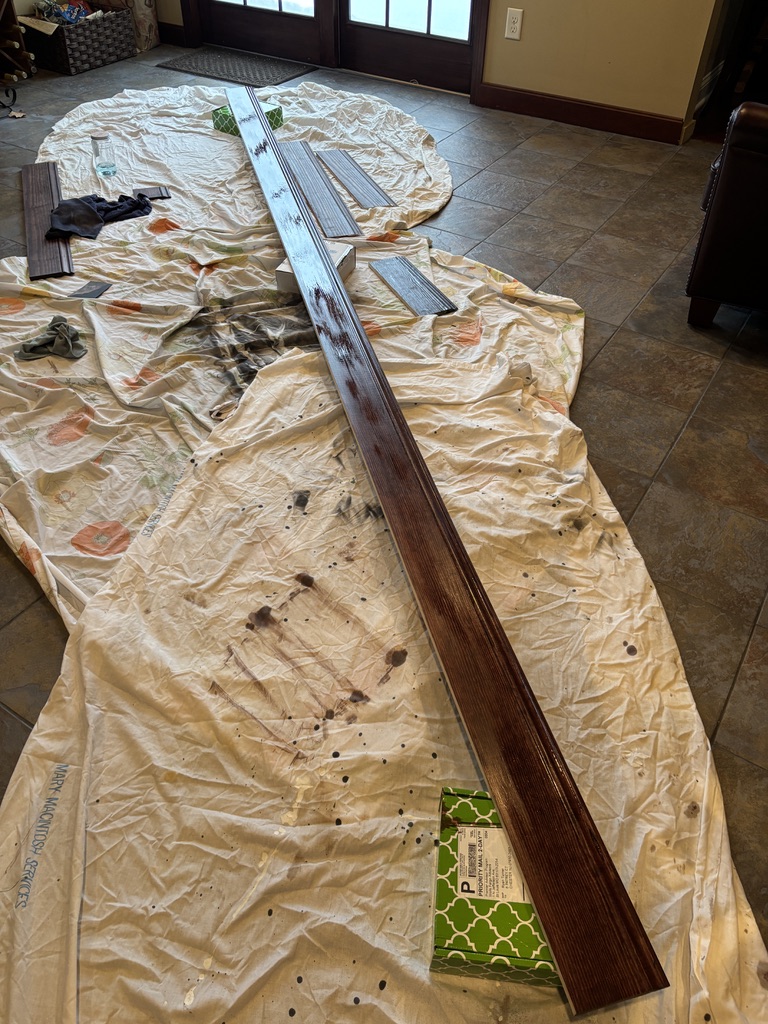
I was intending this week to write about my homeowner issues. I spent time finishing baseboard molding to replace what was ruined by our water damage. I intended to write about how I learned to add a coat of wood conditioner before I stained and to sand between coats of poly from my years of watching my parents restore a 150-year-old farmhouse and my dad’s patience teaching me as we remodeled my basement in my first home. I figured I could tell stories about the fort that my dad built with my kids in our backyard during Covid. I could even slip in the trips with the Appalachia Service Project and how I installed baseboards using all the tricks I knew from my past.
Then, just this weekend, I found water near our basement ejector pump, and I spent time diagnosing and solving this problem. As I got out the screwdriver to tighten couplings to see if I could get the water to stop spewing like Niagara Falls, I thought to myself, “Yes, I need to write about home ownership this week.” Given that we also had to have our furnace replaced this week, I felt like I had my theme.
But I know that home repair and remodeling is not how I actually want to spend my free time. It’s just what I had to do this week. I watched my parents do it for most of their lives during their free time, and I appreciate what they did. But it’s not my thing.
So rather than the myriad of home-life things that actually did take my time, I’m contemplating my need to take a break from work and relax on a snow day. I didn’t have kids at home to frolic in the snow – also not my thing – so I just crashed on the couch, listening to podcasts and playing on my phone.
Content to know I have some skills to contribute to a renovation, if ever needed.
College students, it turns out, are not all that different from babies. They sleep. They eat. They play. Seeing my kids fall into that pattern over their semester break reminded me of early TwinLife, before things got activity-busy. My kids’ lives were organized around very basic needs; my husband and I had to adjust to their rhythms.
The difference this time (aside from the fact I didn’t have to change any diapers) was that I was not the rule maker. Rather, I had stepped fully into the role of mentor – watching, listening, sometimes nudging, but mostly trusting them to create their own rules and make their own decisions. That shift has been happening gradually over the past year, accelerating after graduation, and becoming unmistakably real when they went off to college. People have told me that it can be tense when the kids come home – they want the freedom they have had in the dorms yet parents expect them to follow the rules of the house. Over this first semester break, I tried really hard to minimize the tension, choosing to see my kids as emerging adults who needed a mentor more than a task master.
Mentoring was on my mind quite a bit last week as I prepared for the semester. I spent much of the week designing and testing an AI agent—an Ikigai coach to help students think through their sense of purpose: what they’re good at, what they love, how they can contribute to the world, and how they might make a living doing so. Part of my task in designing the new college at my university is to rethink the role of a faculty member. If knowledge can be accessed anytime, anyplace, then the proverbial “sage,” a faculty member who is an expert in a particular (slice of a) discipline, is not as important as a guide who can help students curate the knowledge and skills they need to reach their goals in life. The role feels far less like designing traditional instruction and much more like mentoring—helping students design their own pathways rather than handing them a predetermined one.
As part of preparing for the semester, I was also getting a physical space ready for the first cohort of students in the new college. The small building had previously been used as administrative office space. It had been emptied, but not yet transformed into a learning environment. My students and I will be tackling the design of the space together, but in an effort to spend some meaningful time with my daughter before she headed back to school, I asked her to go to the thrift store.
As we walked in, joking and bantering, she asked, “So what are we shopping for?” I hadn’t fully articulated it until that moment. “I’m looking for things to inspire the design of my new space at the college,” I said. “Let’s see what speaks to us.”
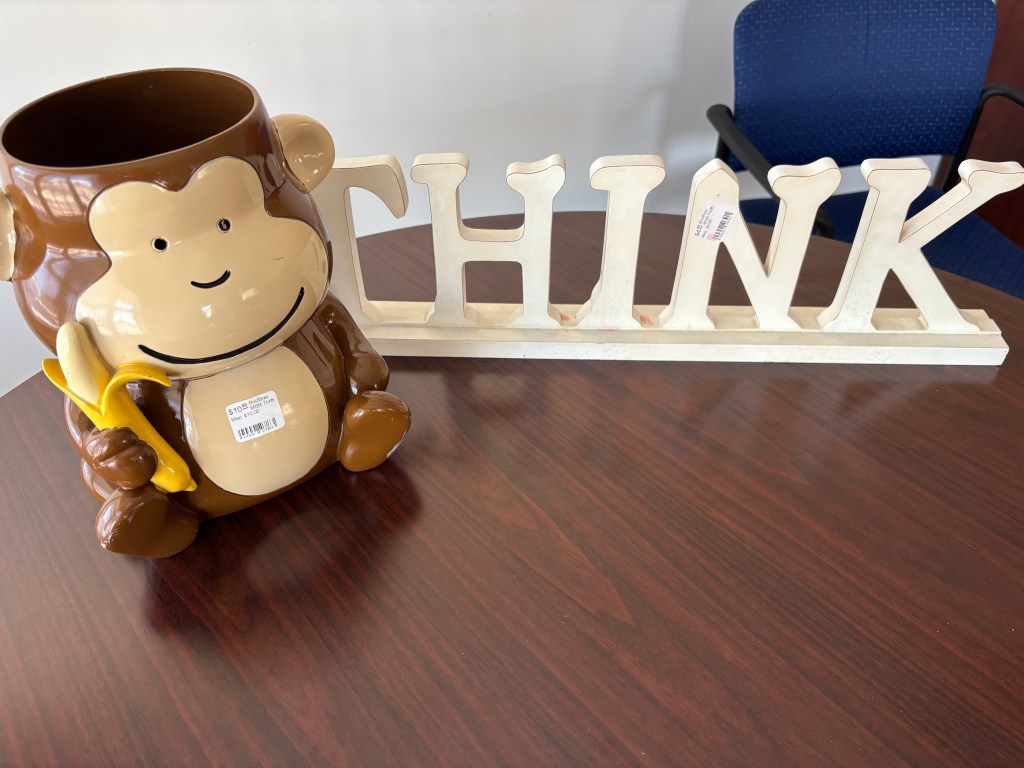
Almost immediately, I spotted a monkey jar. We both loved it. Seriously, we were cooing over its cuteness. We wandered the store, but I kept circling back to that jar, imagining it filled with candy. It was playful; it had character; it was an invitation to think a little differently, to be a little different. Then my daughter noticed a sign sitting high on a shelf that simply read: THINK. She said, “This feels like the space you and your students are going to create.” She was right.
Before we left, I found a coffee urn. I make a lot of coffee for gatherings and events, and it felt practical and symbolic all at once. I walked out of the store with three things: a monkey jar, a sign that says THINK, and a coffee urn—the beginnings of a space designed not just for work, but for connection. I’m reframing my learning space as one of connections, where my team of learners can show up as they are and chart their own paths.
This is a complete reframing of how traditional college courses operate. While many faculty invite their students to connect and to think, the overwhelming majority of the work is driven by syllabus expectations, not by the students’ passions, interests, and personal life goals. Reframing puts students truly at the center – and I’m hoping they take my invitation to monkey around a bit on our path of learning to think.
I had some more quality time with my daughter as I drove her back to school, stopping at my parents’ house to visit along the way. While we were chatting, their cat was sleeping nearby, purring so loudly it filled the room. I commented that since it was asleep, it wasn’t really purring; it was snoring. We joked that human snoring wasn’t as tolerable, and I suggested that maybe if I reframed my husband’s snoring as purring, I would find it more tolerable. The irony, of course, is that my husband hates cats, so we had a good laugh–which woke up the cat!
The idea stuck with me through the weekend–not seeing my husband as purring (though I still find it hilarious) but of reframing what we know so that we can imagine a different experience or future. Perhaps this is why it was a little easier this time to step back into the empty nest as both my children headed back to college. Reframing my “kids” as “adults” helps our relationship grow into the next phase and makes it easier to let them go each time they take another step down their own path. There’s a lot of reframing happening in my life right now. And I’m excited to see where my path is headed.
When my husband was about 6 years old, his parents purchased a small vacation home on a lake in Vermont. Because my mother-in-law won a motor boat by getting the secret square on Hollywood Squares (that’s a fun story!), my husband started water skiing when he was young. More importantly, because the house was just a mile or so from a ski mountain, he also started snow skiing before he started most of the sports that dominated his athletic life. To this day, I am awed when I watch him ski.
My husband and I bonded over the fact we were both athletes. He was an all-state soccer player. I was a female who played on the boys’ team because my high school didn’t have girls’ soccer. He was a varsity tennis player. I was all-conference first-team in basketball. We both understood what it took to be an athlete.
But there is something about skiing that is not innate to someone who first hitches skis to their feet when they are an adult. It’s harder to learn when your center of gravity is not close to the ground, I think.
My husband and I started dating our freshman year in college, and at spring break that year he asked me to go to his family’s Vermont house to ski. I was young and in love and somewhat athletic, so of course, I said, “I’d love to!” My experience with skiing to that point had been a few trips around our family farm on cross-country skis, which included a short, 4.75% grade down our “back hill” (totally making up the slope in order to get my dad to comment on this post) and a single trip to a small hill in the Poconos on downhill skis when I was either in middle or high school. I literally don’t remember much about it other than what I needed to do in order to survive. The answer was “pizza.” I could do that. In my experience, all I knew about skiing was that going down a hill wasn’t all that difficult for this varsity athlete.
However, I had never actually been on a real ski mountain. It was a new challenge, to say the least.
After that first trip, I knew I had fallen in love with a boy who (1) taught me to ski by taking me up the first lift and then, literally, pushing me down the mountain, and then (2) patiently skied with me the rest of the day. I’m pretty sure he knew at the end of the day that he had fallen in love with the girl who survived it.
Over the last three decades (plus!), he has taught me to ski – both on water and on land – but it wasn’t easy for me, and to this day, I am the worst in my family. But I’m okay with last place because it means we gave the gift of skiing to our children. Even though it was hard to get to Vermont with our work schedules and our kids’ activities, I knew it was important that they have the same opportunity their dad did. Learning to ski as a child — just like any other talent – is much easier than learning as an adult. The pain just doesn’t hit you in the same way, so the fear just doesn’t grow. Starting as a child was a gift I could give to them, and I made sure it happened.
While my kids were learning to ski, I was getting better. From that pizza-gate moment when my husband pushed me down the hill to my adult life, I have skied an average of 1-2 times per year, and I have developed competence (if not love for) black diamonds in Vermont. I did not, however, love the “not groomed” trails at the ski mountain last week when we took our family vacation to the resort where my kids had been skiing since they were in pre-school. My husband has skillz. My kids have no fear. I, on the other hand, should never listen to their assurances that I could absolutely handle the “very short” cut-off trail that was marked “ungroomed.”
After getting my ski stuck in a tree branch that had fallen across the path and then sliding backward, out of control, down the icy trail until I stopped screaming (swearing) at my son to get out of my way, I looked to the beautiful, Vermont sky and said a small thanks that my children had learned to ski when they were young, not an adult. I also praised the time I got to spend with them on the mountain.
Later that day, I was sitting in the outdoor hot tub next to an 86-year-old man who had competed in a downhill race as part of the “70+ Ski Club” and who was traveling to France next month to ski more challenging terrain. The hotel was filled with 70+ skiers (plus the 65-year-old we met at the bar and told us she had a fake ID to get into the group), who traveled the world to ski together. I thought to myself, “Why would anyone want to do this to their bodies when they are older than I am right now? Why am I even doing this now?” But as I listened to that man talk about his life of skiing, his military service, and most of all, his kids and grandkids, I understood why I was there. I was celebrating the gift my husband and I had given our kids.
I spent my time this last week reflecting on my past, congratulating my parenting, and wondering about my future. I know I won’t be joining the 70+ ski club, but the community they have created around a common love makes me wonder how I can better fill my time.
When I work alone, it takes two hours to deconstruct my house of Christmas decorations. This is always how I spend my time on New Year’s Day. It was not how I spent the bulk of my time last week, however.
Though most people assume that professors get lots of time off–summer, fall, winter, and spring break–I have never really had that time off. For the first part of my professor career, when I was raising young twins, I spent every break either taking care of my kids or writing toward tenure. After tenure, I took on more administrative responsibility, so even though my kids were more self-sufficient, I still spent time writing or administrating. Since taking over as administrative leader for a 1-year graduate program nearly nine years ago, I haven’t really had time to take a break. Even when my colleagues are “on break,” I am not. The only week I have any time away from email and the challenges of work is between Christmas and New Year’s.
But last year I had to write an accreditation report. I had hoped to have it done by the end of the semester, but the world had different plans for me, and I spent the only week that I actually get a vacation each year writing that report. Because I have been giving a lot to work over the last decade, I was determined to take my “only” week this year. But, again, the world had different plans.
In several recent posts I have hinted that something big happened at work. Here’s the big blog reveal. My university has been taking a hard look at what we do as a higher education institution. We know that the world is changing, and higher ed (all of ed) is slow to catch up. We also know that more and more teens are electing not to attend college after high school. And more foundationally, we know that higher ed is just not accessible to many people.
When we look at these truths in the mirror, we know that the system needs to change, and I have been working with my colleagues over the last year to imagine what that change might be. This fall, our Board of Trustees approved the creation of a new school at our university–one that would be focused on reimagining higher education. I have been asked to lead it.
As a career educator who has been arguing for over two decades that schools need to change in fundamental ways, the challenge of building a school from the ground up is also an incredible opportunity. As someone who started this blog with the commitment not to fill her time as an empty-nester with work… well, that’s going to be a challenge for me to tackle in 2026.
I spent the last week of 2025 working with the hopes that 2026 will bring something great to my professional life. But I also spent it cleaning out closets, taking down holiday ornaments (and sweeping up tree needles), setting up a home office for my husband (who has been using our dining room since Covid), dealing with unexpected water damage, and cherishing every minute my kids spent in the house. In hindsight, I had a pretty full week! Because my kiddos were so busy connecting with friends over break, I didn’t have to feel too guilty about putting so much into work last week. As I move into the new year, I want to be intentional about “saying yes” to opportunities to fill time that do not involve my new–and exciting–role at work.
This was a different kind of Christmas. Something had fundamentally shifted. It wasn’t just that we changed the traditions, though that’s where the story starts.
For as long as my kids have been alive, Christmas has happened at our house. My brother usually comes back to the East Coast, and because he’s home—and because I made the same commitment to my children that my mom made to hers—we never traveled on Christmas day. Anyone who wanted to come to our house was welcome, but we stayed put, allowing Christmas magic to reside in TwinLife. Because we were the only ones with grandchildren on either side, everyone congregated at our house. Ten people around the Christmas dinner table. My brother and I in the kitchen. The kids spending time with their grandparents. Year after year.
This year, though, my brother couldn’t make it due to scheduling complications. It was going to leave a big hole in our tradition. As I wrote in another post, I hosted Thanksgiving for the first time, which meant I poured a lot of energy into that holiday. At the same time, I was finishing the semester and launching a new job (I promise I will write that post very soon!). As I faced another holiday that would already be different without my brother, I decided that the best thing I could do was not host Christmas. In addition to giving me time off in the kitchen, if we travelled, I could give each set of grandparents uninterrupted time with the kids. However, I wanted to stay true to TwinLife tradition and wake up on Christmas morning in our home.
So I set the plan in motion.
Last week was full of travel! First we went to my parents’ house, an old farmhouse they’ve lovingly restored over the past (almost) fifty years. My mom decorates for Christmas meticulously. Almost every decoration comes down and is replaced with something holiday-specific. It’s a beautiful, intentional space to be in during the holiday season, and in honor of her past commitment to her own kids to always be home at Christmas, I wanted to wake up at the farm on Christmas Eve. After a white-knuckling drive through a snowstorm, we made it to their house, enjoyed an early Christmas dinner (not cooked by me!) and exchanged presents. We woke up on the 24th to my dad’s roaring fire in the kitchen hearth, and headed home later in the day, ready to celebrate Christmas day as a family of four.
The plan was to stay home all day, hanging out together, watching Stranger Things and football. I was even going to make lasagna for dinner – not something we usually eat on Christmas but a dish that requires much love for my family for me to prepare, a fitting choice for a family-oriented holiday. We were then headed to my in-laws on the 26th for breakfast (also not prepared by me!). However, on the drive back from my parents’, I checked the weather app, and I noticed a snowstorm loomed for the day after Christmas. Because my daughter’s work schedule ramped up starting the 27th, we realized we wouldn’t be able to see my in-laws at all if we stuck to the plan.
So we shifted gears and for the first time in my kids’ lives, we drove somewhere else on Christmas day.
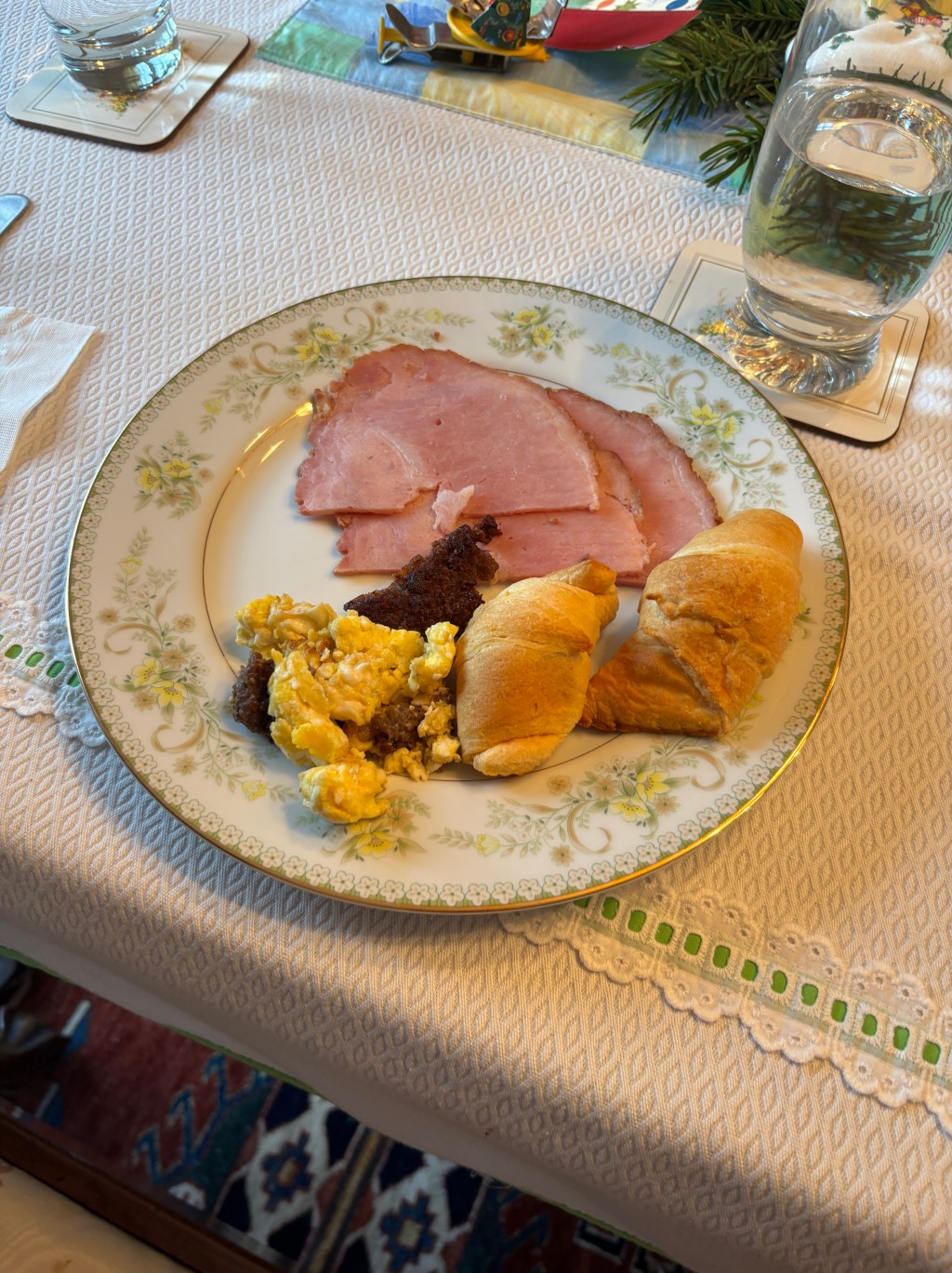
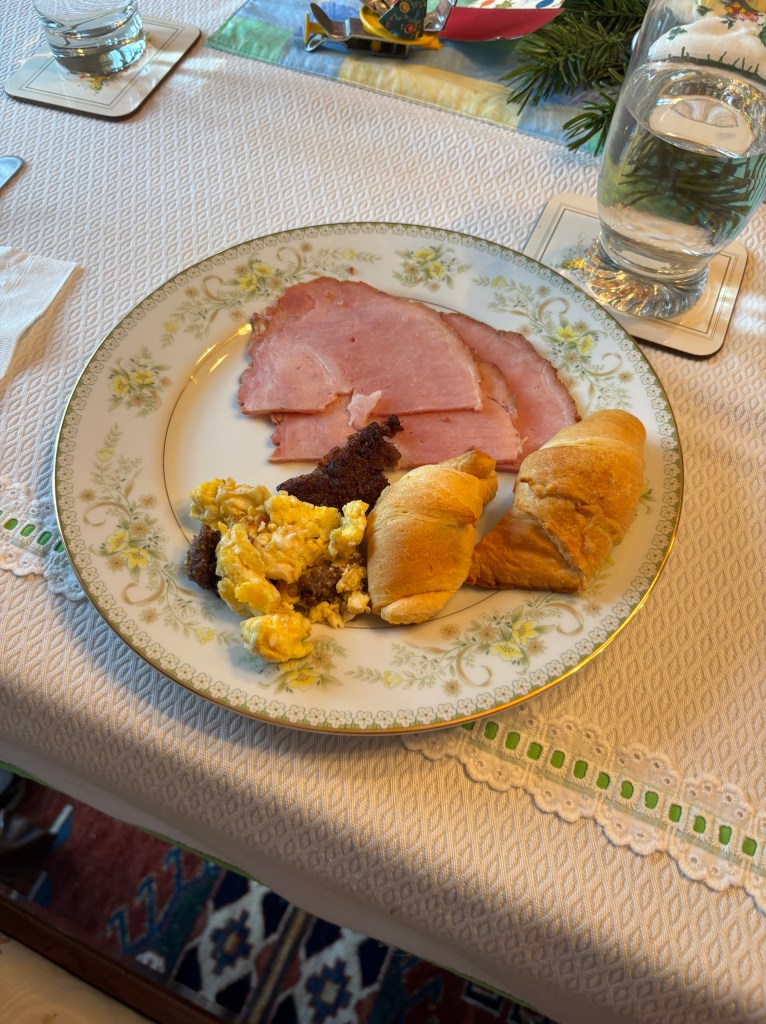
After the kids pulled their teenage selves out of bed, opened presents, and ate french toast (yes, I did cook something on Christmas) and drank our traditional hot mulled apple cider, we hopped in the car and drove to my in-laws’ house. Because they hadn’t planned on us being with them for Christmas dinner, my father-in-law, who was in charge of the meal, decided to combine the small ham they had planned for them with the sausage and eggs they were going to make for us for breakfast. We had a “Committed Pig” protein-packed dinner. There wasn’t a vegetable in sight (unless you count the unbaked potato we decided not to bake)! It was absolutely perfect–mostly because I wasn’t in charge. For the first time in a long time, I got to experience Christmas outside of the kitchen.
What truly made this year different, though, wasn’t where we were or what we ate. It was the time with my kids. I asked them how they felt about splitting the grandparents and not having our “normal” Christmas. They paused. I could tell it felt different to them. It felt different to me. It’s a tradition, and traditions matter. But they also understood that this was the right move in a transitional year, as they enter into adulthood.
“Yeah,” they said. “It’s okay. New traditions.”
And in that moment—and in the way we moved through those days—I realized something. My kids are adults now.
Even last year, when they were seniors in high school, Christmas still carried that familiar childhood energy: surprises, anticipation, the magic of not knowing what was under the tree. This year, all four of us had essentially picked out our own gifts. There weren’t many surprises, and nobody missed them. My kids’ stockings were filled with practical things they needed in their dorm rooms–deoderant, immunity booster, lip balm. The social media meme about the difference between opening socks as a kid and as an adult rang true. My son was genuinely excited to get the socks and sweatpants he had picked out.
The shift from childhood to adulthood was palpable. The new traditions made it visible, but it was the underlying change—the way we filled the time, the way we made decisions together, the way joy showed up differently—that made this Christmas feel fundamentally different.
And, in its own quiet way, just right.
We were back in our own home before bedtime on Christmas day, and we spent the next day filling time individually. I did end up cooking the lasagna that night. Normally I would sneak some spinach into it, but because I hadn’t gone to the grocery store to prepare to host Christmas and our CSA had ended the week before, there was no green to hide among the cheese. We didn’t have vegetables. Just layers of pasta, sauce, and cheese.
My husband said it was a particularly delicious lasagna.
And that compliment felt like the perfect closing note to this different kind of Christmas.