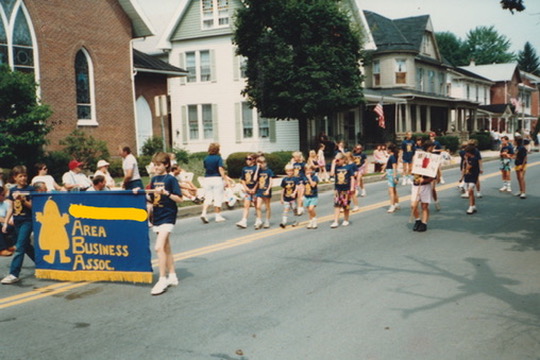
As a child, I knew I was a bicentennial baby. It must have been a phenomenon in 1976 because I was proud of it, to have been born in a celebratory year for our nation. Perhaps the internal fascination with the term “bicentennial baby” helped me to love July 4th. More likely it was the amazing celebration our small, rural town put on each year. Parade, featuring John Deere tractors, fire trucks, and more candy than a kid could want. Pool Games, complete with relay races, dive competitions, and the super duper coin toss (sponsored by the local bank). Park Carnival, calling us with hot dogs, dunk tank, and Bingo. And Fireworks, of course, by the river to end the day. I spent every July 4th of my childhood and high school memory in town, celebrating.
It was truly small town America, and it was ingrained in me. At my core, it is who I am, even if I’ve lived more of my life outside of that space than in it.
Perhaps it was the connection to the 4th and to 1976 that made me fascinated by American history, so much so that I became a history major with a concentration in American history. More likely it was the stories told by my high school history teacher, who inserted the tiniest details that captured my interest and who always included the juicier aspects of our country’s development, often as side notes to the major events, but always in a way that made my ears perk up during the long lectures. I was so eager to know more about the Lindbergh kidnapping that I may have married my husband simply because I learned he lived on the road where the baby had been found. (Side note: Been listening to a podcast recently about the kidnapping, and I wish I could talk to Mr. Corman about all the theories presented!)
All this to say, I love this country. I love its history, even when it makes me uncomfortable. I love the promise it presents. I love that my family could move from poor immigrants to PhD in just three generations. I also recognize there is privilege in my story, privilege that cannot be denied and should not be ignored.
So the Fourth of July is special to me, but this 250th celebration has been complicated because the country is so divided. On top of that, my town (and the entire county where I live) got hit by another major storm on Friday night. With power outages and downed trees everywhere, celebrating 250 seemed less important in the grand scheme of things.
So it was a quiet day. It was also incredibly hot. I spent some time in the pool with my family, listening to the playlist my husband and kids have cultivated over the years. As I floated in the 92 degree water, which gave just a little relief from the ridiculous air temp, I caught myself singing to Shame on You by the Indigo Girls. The Indigo Girls have been part of the soundtrack of my adulthood. It was one of the few bands both my husband and I loved in college, and my a cappella group sang two of their songs often enough that I still know every word. That’s why it surprised me when I realized I wasn’t just singing along anymore. I was actually listening.
The verse that caught my attention and brought the long lost song into my consciousness:
They say, “We’ve been looking for illegal immigrants
Can we check your car?”
I say, “You know it’s funny
I think we were on the same boat back in 1694″
As I came out of my heat haze, I started to listen, really listen. Though I had heard the song dozens of times before – enough to have it ingrained in my unconscious memory – I listened to it with new ears. I couldn’t help but realize how timely it still felt. The song is three decades old, yet it could have been written yesterday. My brain started humming.
After the pool I took a heat break on the couch and surfed Netflix, which supplied me with the trending movie The Long Walk Home. I had never seen it, but I was curious about both the context and the actors whose names I knew well. A very young Whoopi Goldberg (married to a man played by a very young Ving Rhames) tells the story of the Montgomery Bus Boycott through the eyes of two women (Whoopi and Sissy Spacek) who represent two sides of the movement. At one point I said to my husband, “We’re farther away from the release of this movie than the movie was from the events it depicts.”
That realization made me pause. The movie was released in 1990. The events it portrayed began in 1955. It seems that in approximately the same time span the same questions have returned. Watching the movie forces you to face the uncomfortable truths of how Black people were treated in the Jim Crow era. My parents were alive then. It wasn’t that long ago. And sometimes, as a student of history, I wonder whether we learned any lessons. The movie piled onto the song as I continued through my weekend.
The next morning, during my walk, I listened to a podcast that referenced Thomas Paine, one of the driving forces of the Revolutionary cause. In his pamphlet Common Sense, Paine wrote, “In America, law is king.” The concept that no person was above the law, that no person should rule over another individual was a principle on which the country was built.
Lately, I feel like we are wrestling, once again, with what it means for law — not individuals, not parties, not power — to be king.
The podcast piled on.
A song. A movie. A podcast. At work I’m creating a keynote and a workshop to be delivered in the next month that argues that media creation is what defines literacies of today — and the future. Three unrelated pieces of media had surfaced together in my world, helping me to reflect on a very significant moment in the history of the United States. As someone who spends most of her hours learning and teaching, I like to think that learning works most beautifully in these in-between moments, where unexpected connections are made.
The media presented a pattern to me: one of both aspiration and contradiction. The American experiment proposed something radical at its time — that humans can collectively rule themselves and that no one person is above others. At the same time, the founders struggled with their past, their individual economics, and their inherited prejudices. Freedom was not granted to slaves. Women did not have rights. Entire groups of humans were excluded from participation in the best experiment in human governance the world had yet seen.
But the Constitution also stated that it was an attempt to form a “more perfect union.” It was a first step on a journey that recognized that no one — and no thing — is perfect. It is a process of becoming, and that process is uncomfortable, messy, and celebratory all at the same time.
As this bicentennial baby approaches her fiftieth birthday, I find myself grateful that I still have new things to learn about a country I love. Patriotism, I’ve decided, isn’t believing America has always gotten it right. It’s believing the promise of a “more perfect union” is still worth pursuing. Perhaps that’s the work of every generation: to inherit the promise, confront the contradictions, and leave the union just a little more perfect than we found it. In that case, filling my time with listening, observing, questioning, reflecting, learning — and contributing — seems like time well spent.


Leave a Reply